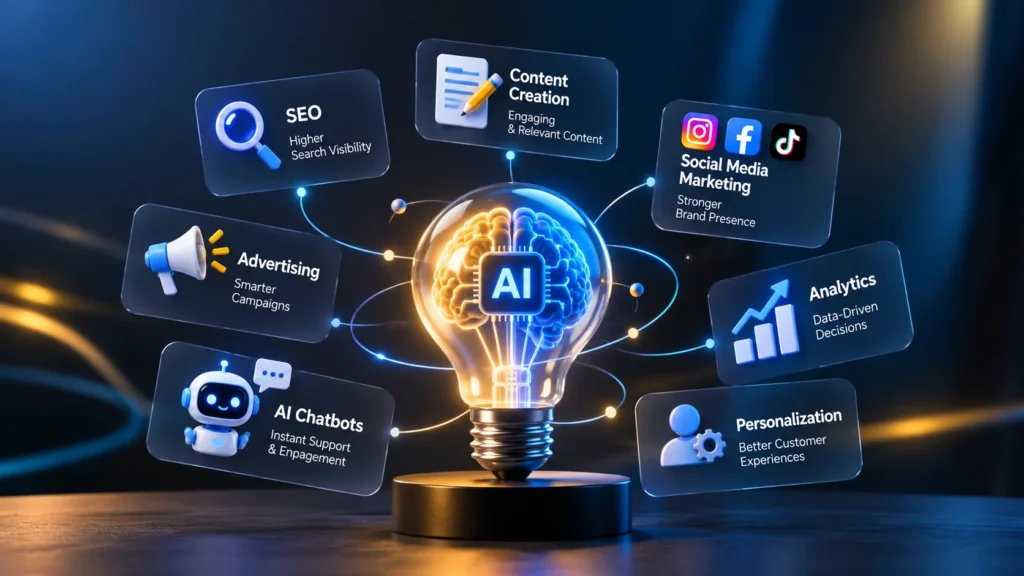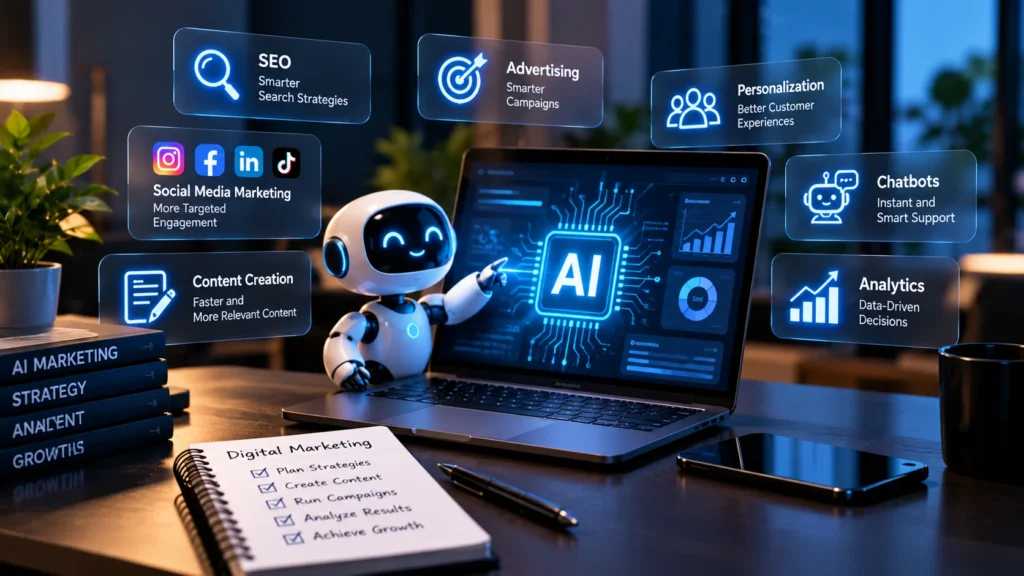
AI in Digital Marketing is changing how businesses connect with customers, create content, and improve marketing performance in 2026.
Digital marketing has changed significantly over the years, transforming how businesses communicate with customers, promote their products, and establish their presence in competitive markets. Earlier, companies depended heavily on traditional advertising methods such as newspapers, television commercials, radio promotions, and printed materials to reach potential customers. The development of the internet introduced new opportunities through websites, search engines, social media platforms, and online advertising. Today, another technological development is influencing the industry: artificial intelligence. This shift explains why AI in Digital Marketing has become an important topic for businesses planning their online growth.
Artificial intelligence is playing a growing role in how digital marketing activities are planned, managed, and improved in 2026. Businesses are exploring AI-powered technologies to understand customer preferences, improve marketing campaigns, create engaging content, and manage communication more efficiently. Activities that previously required considerable manual effort can now receive support from intelligent software capable of organizing information, recognizing patterns, and generating useful suggestions.
Artificial intelligence is not simply about allowing machines to complete marketing tasks. Its broader value lies in helping businesses make informed decisions, understand changing customer expectations, and develop more relevant marketing experiences. From identifying suitable keywords for search engine optimization to recommending products based on customer interests, AI is influencing different stages of the marketing process.
The increasing availability of AI tools is also creating opportunities for smaller businesses. Organizations that previously lacked the resources to invest in advanced marketing technology can now explore accessible applications for content planning, customer service, performance reporting, and campaign management. However, adopting artificial intelligence does not automatically guarantee improved results. Businesses still need clear objectives, accurate information, creative thinking, and a strong understanding of their audiences. AI in Digital Marketing works best when teams connect the technology to a specific customer need rather than treating automation as an end in itself.
Another important consideration is the relationship between technology and human expertise. Although AI can assist with research, content development, and data analysis, successful marketing still depends on communication, emotional understanding, and strategic judgment. Customers want meaningful experiences, trustworthy information, and solutions that address their actual needs.
Understanding how artificial intelligence is changing digital marketing in 2026 is therefore essential for business owners, marketing professionals, students, and anyone interested in the future of online business. This article examines the major applications of AI in digital marketing, its advantages and limitations, practical business examples, and the opportunities it may create in the coming years.
Table of Contents
Toggle1. Understanding AI in Digital Marketing and How It Works
Artificial intelligence refers to technologies that enable computer systems to perform tasks involving capabilities associated with human intelligence. These activities may include interpreting language, recognizing patterns, analyzing information, generating content, and making predictions based on available data. AI helps marketers analyze information, improve their strategies, and create more relevant interactions between businesses and potential customers.
Marketing involves collecting and interpreting information from different sources. Website visitors leave behavioral signals through the pages they explore, advertisements generate performance data, customers submit enquiries, and social media audiences interact with content in different ways. Examining this information manually can become difficult, particularly when a business operates across several digital platforms.
AI-supported systems can help organize these large collections of information and identify patterns that may otherwise be overlooked. For example, an online clothing store may discover that customers who purchase certain products frequently explore related accessories. A recommendation system can use this information to suggest relevant items during future shopping sessions. In practice, AI in Digital Marketing turns scattered customer signals into information that marketers can review and act on.
Similarly, a business providing professional services might use an AI-supported chatbot to answer common questions, explain service categories, and guide visitors toward suitable contact options. These applications demonstrate how artificial intelligence can assist both customer-facing activities and internal marketing operations.
Different technologies contribute to these capabilities.Machine learning enables software to recognize patterns in information and refine its predictions as it learns from additional data. Natural language processing enables software to interpret and generate human language. Generative AI can create written drafts, images, audio, and other materials based on instructions. Predictive analytics examines past data to identify trends and make informed forecasts about what may happen next. Artificial Intelligence in Digital Marketing can support the research process, but businesses should still check whether the insights match real customer behavior.
Although these technologies have different functions, they can work together within marketing platforms. An advertising system may use machine learning to optimize delivery, while a content assistant may use generative AI to suggest headlines or prepare campaign drafts.
However, AI cannot fully recognize a company’s unique needs, goals, and challenges without relevant information and human guidance. Its usefulness depends on the quality of the information it receives, the tasks it is designed to perform, and the decisions made by the people using it. Recognizing what AI can and cannot do allows companies to use it effectively as a supporting tool instead of expecting it to solve every marketing problem.
2. AI in Digital Marketing for Content Creation and Creative Development
Content marketing focuses on creating and sharing information that attracts, educates, and engages a defined audience. Businesses use articles, videos, newsletters, infographics, case studies, and social media posts to explain their offerings and build relationships with potential customers. Artificial intelligence is changing the process of developing these materials by introducing new possibilities for research, planning, and production. Artificial Intelligence in Digital Marketing can support this process, but original insights and careful editing remain essential.
AI Content Ideas and Planning
One of the most common challenges in content marketing is generating suitable ideas consistently. A business may understand its products but struggle to identify topics that interest customers. AI tools can help explore possible subjects based on audience questions, industry themes, and marketing objectives.
Imagine a skincare company preparing informative posts for Instagram alongside helpful articles for its website. It may want to discuss skincare routines, ingredient awareness, product application, and common customer concerns. An AI assistant can help organize these themes into a content calendar and suggest different formats for presenting the information.
The marketing team can then select topics that match its expertise and audience needs. This is important because AI-generated ideas may appear relevant without reflecting the company’s actual products or customer concerns. Practical AI Marketing Strategies start with a clear goal, a defined audience, and a way to evaluate results.
AI-Assisted Writing and Creative Production
Generative AI can also support writing. Marketers may use it to prepare initial outlines, draft captions, suggest article structures, or develop alternative headlines. This can make the early stages of content production more efficient, particularly when a team is managing several campaigns.
However, creating large amounts of content quickly is not the same as creating valuable content. Automatically generated writing may contain repeated ideas, unsupported statements, or explanations that lack practical depth. Businesses should review and improve drafts before publication, adding original observations, accurate information, and relevant examples.
Brand identity is another important consideration. Every business communicates differently. A financial consulting company may prefer a professional and precise tone, while a fashion brand may use expressive and conversational language. AI can be instructed to follow writing guidelines, but human review is necessary to ensure that the final message reflects the brand appropriately.
AI is also influencing visual content development. Creative teams can use image-generation and editing applications to explore campaign concepts, prepare mockups, and experiment with different visual arrangements. Video production tools may assist with subtitles, editing, audio improvements, and adapting longer recordings into shorter clips.
These capabilities can make creative experimentation more accessible. A small business may be able to visualize several advertising concepts before investing in a full production process.
Nevertheless, generated visuals must be used responsibly. Product images should not misrepresent actual features, and promotional content should not create false expectations. Customers rely on marketing materials to make decisions, so accuracy and authenticity remain essential.
The greatest opportunity lies in combining AI assistance with human creativity. Technology can generate possibilities, but marketers must decide which ideas are meaningful, distinctive, and appropriate for the people they want to reach.
3. Artificial Intelligence in Digital Marketing for Social Media
Businesses of all sizes now use social media to connect with customers, share updates, and strengthen their online presence. Platforms such as Instagram, Facebook, LinkedIn, and YouTube allow brands to share information, demonstrate products, interact with customers, and build communities around their offerings. Managing these activities effectively requires planning, creativity, and continuous evaluation. For social platforms, AI Marketing Strategies are most useful when they support genuine conversations rather than replace them. A useful application of AI in Digital Marketing is comparing content ideas against the questions customers actually ask.
Artificial intelligence is helping marketers handle some of these responsibilities more efficiently. AI-assisted planning applications can suggest content themes, organize publishing schedules, and prepare initial drafts for different platforms. This can be useful for businesses that need to maintain a consistent presence while managing other operational activities.
For example, a restaurant may develop a monthly social media plan that includes menu highlights, behind-the-scenes videos, customer experiences, seasonal offers, and educational posts about ingredients. AI can help organize these ideas into a schedule, while the restaurant team supplies genuine photographs, accurate information, and its own personality.
AI Social Media Analytics and Engagement
AI-supported analytics can also help marketers interpret engagement patterns. Social media platforms generate information about views, interactions, audience characteristics, and content performance. Reviewing these results can help businesses understand which types of posts attract attention and which encourage meaningful actions.
A clothing brand might notice that short styling videos generate more product enquiries than ordinary promotional images. This observation could encourage the brand to experiment with additional styling content. However, marketers should avoid assuming that every performance difference is caused by content format alone. Timing, audience interests, platform behavior, and seasonal demand may also influence results.
AI can also support social listening by helping brands understand online conversations and audience opinions. Businesses may receive large numbers of comments, reviews, and public mentions. AI-supported analysis can help identify recurring questions or concerns within these conversations.
A delivery company may notice that several customers are expressing dissatisfaction with how their orders are packaged. Instead of focusing only on social media responses, the company can investigate its operations and improve the underlying customer experience. Artificial Intelligence in Digital Marketing can help teams adapt content formats while keeping the underlying message consistent.
AI can also assist with responding to routine messages, but automated communication requires care. Customers asking simple questions may appreciate quick answers, while people experiencing complicated problems often need direct human support.
A brand’s social media presence should feel relevant and responsive rather than entirely automated. Authentic interactions, original ideas, and genuine customer understanding remain important for building long-term relationships.
In 2026, AI is making social media management more organized, but effective communication still depends on recognizing that every follower represents a person with individual interests, expectations, and concerns.
4. AI Marketing Strategies for Advertising and Campaign Optimization
Paid advertising plays a major role in digital marketing because it allows businesses to promote products and services to selected audiences. Search advertisements, social media campaigns, display advertising, and video promotions provide opportunities to reach potential customers at different stages of their purchasing journey. AI in Digital Marketing can assist with ad testing and optimization, while marketers remain responsible for budgets and results.
Artificial intelligence is influencing advertising through automated bidding, audience analysis, creative assistance, and performance optimization. Many advertising platforms use machine learning to estimate the likelihood that a particular interaction will contribute to a campaign objective.
For example, an online furniture retailer may run a campaign designed to generate purchases. The advertising platform can use available signals and historical performance information to adjust delivery and bidding decisions. This can reduce the need for marketers to manage every individual advertising opportunity manually.
AI-supported systems can also assist with audience targeting. Rather than depending exclusively on narrowly defined manual audience selections, some platforms use predictive models to identify additional users who may be interested in an advertised product. Effective AI Marketing Strategies for social media combine scheduling assistance with authentic conversations and original visuals.
However, businesses still need to understand their ideal customers. A company selling premium office furniture should know whether it primarily serves corporate offices, interior designers, or individual professionals. Without this knowledge, automated optimization may produce activity that does not fully align with business priorities.
Creative Testing in AI Marketing Strategies
Creative development is another area where AI can help. Marketers may generate multiple headline ideas, advertising descriptions, or visual concepts for testing. A travel company promoting holiday packages could explore messages emphasizing convenience, relaxation, family experiences, or unique destinations.
Testing different approaches can reveal which messages connect more effectively with the intended audience. However, advertising performance should be evaluated using meaningful business measurements rather than attention alone.
A campaign may generate thousands of impressions and clicks while producing very few qualified enquiries. In such cases, marketers should examine landing page quality, audience relevance, advertising messages, and conversion tracking.
AI cannot guarantee profitable advertising. Campaign outcomes depend on competition, customer demand, budgets, product quality, and many other factors. Automated systems also require accurate tracking information to optimize toward suitable goals.
The responsibility of the marketer is to establish objectives, evaluate performance, and decide whether advertising expenditure contributes to the business.
Artificial intelligence can make campaign management more efficient, but successful advertising still requires strategic planning and continuous human oversight.
5. AI-Powered Personalized Customer Experiences
Modern customers encounter large amounts of online information every day. Businesses therefore face the challenge of making their communication relevant without overwhelming audiences with unnecessary messages. Personalization offers one way to address this challenge by adapting experiences according to customer interests, preferences, and previous interactions. One practical use of Artificial Intelligence in Digital Marketing is to make relevant recommendations without overwhelming customers. For paid campaigns, AI in Digital Marketing is most valuable when conversion tracking reflects meaningful business outcomes.
Artificial intelligence can support personalization by identifying patterns within available customer information. Online stores, for example, may use recommendation systems to suggest products related to items a visitor has explored or purchased.
A customer browsing sports equipment might receive suggestions for related accessories. Someone purchasing books may see recommendations connected to similar subjects or authors. When these suggestions are relevant, they can make the shopping experience more convenient.
AI Email Personalization
Personalization also influences email marketing. Businesses can organize subscribers into groups based on interests or previous engagement and prepare communication suited to those groups.
An educational platform offering courses in design, programming, and digital marketing might send different newsletters to subscribers interested in each subject. This approach can make messages more useful than sending identical promotions to everyone.
AI-supported tools may help identify suitable segments and recommend content variations. However, the business must ensure that the information used for personalization has been collected and processed appropriately.
Protect Customer Data and Trust
Customer privacy is an essential consideration. People may appreciate useful recommendations while feeling uncomfortable if a company appears to monitor their activities excessively. Businesses should communicate transparently about relevant data practices and avoid collecting more information than necessary.
Website personalization is another developing application. Some websites can adjust selected content according to visitor behavior. Returning customers might see recently viewed products, while new visitors receive introductory information about the business.
These experiences should remain easy to navigate. Personalization becomes less helpful when customers cannot access basic information or understand why certain recommendations appear.
The purpose of AI-supported personalization should be to improve relevance and convenience. Businesses that use customer information responsibly can create more meaningful interactions while maintaining trust. AI Marketing Strategies should include regular reviews of campaign costs, lead quality, and the accuracy of automated recommendations.
6. AI Chatbots, Customer Service, and Marketing Automation
Customer communication is closely connected to digital marketing because people often need additional information before making a purchase or submitting an enquiry. Businesses receive questions through websites, social media accounts, messaging applications, and email. Responding to these messages consistently can require significant time, particularly for smaller teams. AI Marketing Strategies can include routine customer-service automation, provided customers can reach a person when needed.
AI-powered chatbots can assist by handling selected routine conversations. A chatbot may explain business hours, describe service categories, provide approved product information, or direct visitors to a suitable contact form.
For example, a training institute might receive repeated questions about available courses, fees, admission procedures, and class schedules. A properly configured assistant could provide general information and guide prospective students toward the relevant department.
This can improve access to information, especially outside normal working hours. However, the chatbot must use accurate, current details and provide a clear option for human assistance when necessary.
AI can also support lead qualification. A business offering website development services might use an automated assistant to ask potential customers about their project type, preferred features, and expected timeline. The collected information can help the team understand the enquiry before responding.
Such systems should avoid requesting unnecessary personal information, and customers should understand when they are interacting with automation.
Marketing Automation and Customer Follow-Ups
Beyond chatbots, marketing automation can support repetitive communication processes. Businesses may create workflows that send approved follow-up messages after a customer submits a form, registers for an event, or requests information.
For instance, a person downloading an educational guide might receive a related email explaining additional resources. These messages should be relevant and respect the recipient’s communication preferences. Artificial Intelligence in Digital Marketing makes personalization possible at scale, but customer consent and relevance must guide its use.
AI can also help organize incoming enquiries, summarize customer interactions, and identify common questions. This may allow employees to spend more time resolving complex issues and developing customer relationships.
Nevertheless, automation should not remove empathy from customer service. A person dealing with a delayed order, incorrect payment, or disappointing experience may require a thoughtful response from an employee.
Automated systems can misunderstand language or provide incorrect information. Businesses therefore need procedures for reviewing responses, correcting mistakes, and transferring conversations when necessary.
The most effective approach is to use AI for suitable routine activities while preserving human involvement in situations requiring judgment, sensitivity, or detailed problem-solving.
7. AI in Digital Marketing Analytics and Performance Measurement
One of the major advantages of digital marketing is the ability to measure different aspects of campaign performance. Businesses can examine website visits, advertising expenditure, customer enquiries, purchases, email interactions, and other activities. Gathering data is the first step, but its real value comes from understanding and applying the insights it provides. AI in Digital Marketing can make performance reports easier to interpret, but the numbers still need business context.
Artificial intelligence can assist with this process by organizing data, identifying patterns, and highlighting unusual changes. Instead of manually examining every report, a marketing professional may use AI-supported tools to summarize important observations.
For example, an online retailer might discover that website traffic increased during a particular campaign while completed purchases remained relatively unchanged. This suggests that attracting additional visitors did not necessarily improve sales performance.
The marketing team could investigate possible explanations, including audience relevance, product pricing, website usability, and checkout difficulties.
AI-supported analytics may help identify which pages experienced higher exit rates or which traffic sources produced fewer conversions. However, these findings should be treated as evidence requiring interpretation rather than automatic explanations. When applied to customer service, AI in Digital Marketing should make it easier—not harder—for customers to reach a person.
Predictive Analytics and Digital Marketing Performance
Predictive analytics extends this process by estimating possible future outcomes using historical information. A business might examine previous sales patterns to anticipate seasonal demand or identify customer groups showing reduced engagement.
For instance, a subscription-based learning platform may notice that customers who stop using its educational resources frequently cancel their subscriptions later. The company could investigate ways to improve onboarding, provide helpful reminders, or make learning materials easier to access.
Predictions are not guarantees. Changes in economic conditions, customer preferences, competition, or business operations can affect future results.
Marketers also need to understand the limitations of measurement. Advertising platforms may report conversions differently, and privacy-related changes can influence tracking accuracy. A campaign’s apparent success should therefore be evaluated using several relevant indicators.
Important measurements may include conversion rate, customer acquisition cost, revenue, return on advertising spend, and customer retention. The most appropriate metrics depend on the company’s objectives.
A local service business may prioritize qualified enquiries, while an e-commerce store may focus on purchases and profitability. A new brand might initially concentrate on reaching relevant audiences and encouraging meaningful engagement.
AI can make performance analysis more efficient, but it does not remove the need to understand business fundamentals.
Marketing success is not simply about generating more clicks, views, or followers. It involves determining whether digital activities contribute to customer relationships, sales opportunities, and sustainable business development.
8. Benefits of Artificial Intelligence in Digital Marketing for Small Businesses
Small businesses often face challenges that differ from those of larger organizations. They may have limited marketing budgets, fewer employees, and less time to manage multiple digital platforms. Artificial intelligence can provide practical support by making certain activities easier to organize and complete. For small teams, AI in Digital Marketing is most valuable when it solves a specific problem and saves measurable time. Responsible AI Marketing Strategies define when an automated response is appropriate and when a conversation should be escalated.
One important benefit is improved efficiency. A business owner responsible for daily operations may struggle to prepare social media content, update website information, respond to customer enquiries, and review campaign performance. AI-assisted tools can help prepare drafts, organize schedules, and summarize information, reducing some of the time spent on routine tasks.
For example, a small bakery may use an AI assistant to develop content ideas for seasonal promotions, organize frequently asked questions, and prepare initial descriptions for new products. The owner can review the material, add accurate details, and ensure that the communication reflects the bakery’s personality.
Another advantage is access to creative support. Small businesses may not always have the resources to employ separate specialists for writing, design, research, and reporting. AI tools can help with preliminary work in these areas, allowing businesses to experiment with different marketing approaches.
These tools can assist with various tasks, but human knowledge, experience, and judgment remain essential. A business may still require assistance with complex advertising strategies, technical SEO, website development, or specialized creative work.
Smaller businesses can use AI to better understand customer preferences and identify useful patterns in their data. A local clothing store might examine common customer questions to understand which products require clearer descriptions. A tutoring center could organize enquiries by course category to identify subjects attracting greater interest.
Businesses can use this information to communicate more effectively with customers and make informed decisions about upcoming marketing efforts.
Cost management remains important. Although some AI applications offer free or affordable access, using numerous subscriptions can create unnecessary expenses.Companies need to determine whether the improvements a tool offers are worth the financial investment required to use it. Artificial Intelligence in Digital Marketing can surface trends in reports, although marketers must still investigate why those trends occurred.
A sensible starting point is to select one recurring problem and test whether AI improves the existing process. If the application saves time, maintains quality, and supports business objectives, the company can consider expanding its use.
Small businesses benefit most from AI when it makes everyday tasks easier and more efficient without creating additional difficulties.
9. Challenges, Limitations, and Ethical Concerns of AI Marketing
Despite its advantages, artificial intelligence introduces challenges that businesses should consider carefully. One of the most important limitations is the possibility of inaccurate information. Generative AI systems can produce explanations that sound confident even when the underlying statements are incorrect. Responsible AI Marketing Strategies require fact-checking, privacy safeguards, and clear approval processes.
In marketing, this can create serious problems. An inaccurate product description may mislead customers, while an unsupported advertising claim could damage a company’s reputation. Businesses should verify factual information before publishing it, especially when content involves pricing, technical specifications, legal requirements, or health-related claims.
Originality is another concern. AI-generated writing may contain familiar expressions or ideas similar to material already available online. Although AI can assist with drafting, marketers should develop distinctive content through original examples, genuine business knowledge, and thoughtful editing.
Businesses must also be mindful of ownership rights and legal responsibilities when using or creating digital content. Businesses should understand the terms governing the tools they use and avoid publishing material that improperly reproduces protected work.
Privacy and Responsible AI Use
Data privacy presents additional challenges. Marketing platforms may process customer names, contact details, purchasing histories, and website interactions. Organizations need appropriate safeguards when using this information with AI applications.
Sensitive customer data should not be entered into tools without understanding how the information will be processed, stored, or shared. Companies should follow relevant data protection rules and create clear guidelines for handling information responsibly. Small businesses can test AI in Digital Marketing through one manageable task before committing to additional tools.
Bias is another limitation. AI systems may produce recommendations or classifications influenced by patterns within their training data. In marketing, this could lead to inaccurate assumptions about particular customer groups or unfair targeting decisions.
Human review is important for identifying and correcting these problems.
Overdependence on automation can also reduce the distinctiveness of marketing communication. When businesses use similar tools and instructions without adding original perspectives, their content may become repetitive and difficult to distinguish from competitors.
Customers often respond to authentic experiences, practical knowledge, and communication that reflects a recognizable brand personality. These qualities require more than automated text generation.
Businesses should therefore establish clear responsibilities for reviewing AI-generated material, approving campaigns, protecting information, and handling mistakes.
Ethical AI marketing involves using technology in ways that respect customers, maintain transparency, and support accurate communication. Long-term trust is more valuable than short-term efficiency gained through misleading or careless practices.
10. AI in Digital Marketing Careers and Essential Skills
The growing use of artificial intelligence is influencing the skills required in digital marketing. Professionals who previously concentrated mainly on content writing, campaign management, or reporting may now encounter AI-assisted features within their everyday tools. Learning how to evaluate Artificial Intelligence in Digital Marketing is becoming a useful complement to core marketing skills.
This does not mean that traditional marketing knowledge is becoming irrelevant. In many situations, understanding marketing fundamentals is what allows professionals to evaluate AI-generated recommendations effectively.
For example, an AI system may suggest changing an advertising campaign’s budget, but the marketer must understand conversion performance, customer acquisition costs, and business profitability before deciding whether the recommendation is appropriate. Budget-conscious AI Marketing Strategies compare time savings and quality improvements with subscription and training costs.
Similarly, AI may produce an SEO article outline, but a knowledgeable professional needs to assess search intent, content quality, website structure, and audience relevance.
AI Skills for Digital Marketers
One increasingly useful skill is writing clear instructions for AI systems. Marketers who explain the objective, audience, tone, format, and limitations of a task may receive more useful outputs.
However, effective AI use involves more than writing prompts. Professionals must verify information, recognize weak suggestions, and improve generated material.
With technology handling more data gathering and reporting tasks, marketers must focus on understanding the results and using those insights to guide business strategies.
Creative thinking remains valuable because technology can generate numerous ideas without necessarily identifying which one will resonate with a particular audience. Understanding customer emotions, cultural context, brand identity, and communication goals helps professionals make better creative choices.
Knowledge of privacy, intellectual property, and responsible technology use is becoming relevant as well. Businesses need employees who can recognize potential risks and apply appropriate safeguards.
For beginners entering digital marketing, a balanced learning approach is useful. They can study SEO, social media marketing, content development, advertising, and analytics while experimenting with AI-supported applications.
Practical projects can help connect these subjects. A student might develop a content calendar for a fictional business, use AI to explore ideas, create original posts, and evaluate the strengths and weaknesses of the process.
The future of digital marketing careers is likely to involve collaboration between human expertise and technological assistance. Professionals who understand both marketing strategy and the responsible use of AI may be better prepared for changing industry requirements.
11. The Future of AI in Digital Marketing Beyond 2026
Artificial intelligence is expected to remain an important influence on digital marketing beyond 2026, although the exact direction of technological development is difficult to predict. Advances in digital marketing tools may allow companies to organize promotional efforts more efficiently, create experiences suited to individual customer needs, and simplify everyday marketing tasks. The future of AI in Digital Marketing will depend not only on better tools but also on customer trust and sound decisions.
One potential development is the integration of AI across different marketing systems. Businesses currently use separate applications for website analytics, advertising, email marketing, customer management, and content production.When different business tools work together, teams can share information more smoothly and spend less time completing the same routine tasks.
For example, a marketing platform might summarize campaign results, identify areas requiring attention, and prepare a draft report using information from connected sources. Human professionals would still need to verify the findings and decide which actions to take. Using Artificial Intelligence in Digital Marketing responsibly also requires careful handling of customer information and generated claims.
Conversational technology may also influence customer discovery. As people become more comfortable asking detailed questions through AI-supported search and assistant interfaces, businesses may need to ensure that their online information is accurate, accessible, and easy to understand.
This does not eliminate traditional website content. Instead, it reinforces the importance of clear service descriptions, trustworthy information, and useful answers to customer questions.
Creative production is another area likely to develop. AI-assisted tools may provide additional options for producing videos, illustrations, interactive experiences, and campaign variations. This could make experimentation more accessible to businesses with limited production resources.
However, increased automation may also make originality more valuable. When generic content becomes easier to produce, businesses that offer genuine expertise, distinctive perspectives, and authentic customer experiences may have stronger opportunities to differentiate themselves.
Customer trust will remain a central concern. People may become more attentive to whether online information is accurate, whether promotional visuals represent real products, and how businesses use personal data.
Organizations that communicate transparently and handle information responsibly may be better positioned to maintain long-term relationships.
The future may also bring changes to marketing employment. Some repetitive responsibilities could require less manual effort, while new tasks involving AI supervision, workflow design, data quality, and technology evaluation may become more important.
Businesses and professionals should approach these possibilities with flexibility rather than assuming that every predicted development will occur.
The most sustainable strategy is to remain informed, test useful applications, and maintain a strong understanding of customers and business objectives.
Artificial intelligence will continue to influence marketing methods, but the fundamental purpose of marketing will remain recognizable: understanding people’s needs and communicating valuable solutions. Learning AI in Digital Marketing means developing both technical confidence and the judgment to question automated outputs.
12. How to Implement AI Marketing Strategies in Your Business
Introducing artificial intelligence into digital marketing does not require an immediate transformation of every business process. A gradual approach allows organizations to understand the technology, evaluate its usefulness, and reduce unnecessary risks. Businesses exploring AI Marketing Strategies should start with a limited experiment and measure whether it genuinely helps.
Step 1: Set Clear AI Marketing Goals
The first step is identifying a clear marketing objective. A business might want to improve content consistency, reduce customer response times, generate more qualified enquiries, or make performance reporting easier. Defining the objective helps determine whether an AI application is relevant.
The second step is reviewing existing activities. Businesses should examine which tasks require substantial time and which processes frequently create difficulties. Repetitive activities such as organizing customer questions, preparing content outlines, or summarizing campaign information may provide suitable starting points.
Step 2: Select Appropriate AI Tools
The third step involves selecting appropriate tools. Cost, functionality, ease of use, privacy policies, and compatibility with existing systems should all be considered. A business should avoid purchasing applications simply because they advertise advanced AI capabilities.
Step 3: Test and Measure Results
After selecting a tool, the organization can begin with a limited experiment.
For example, a small online retailer might use AI to develop draft product descriptions for a selected category. Employees can then review the descriptions for accuracy, clarity, and consistency with the brand.
The business can compare the new process with its previous approach to determine whether it saves time without reducing quality.
Another company might test an AI-assisted reporting system to organize monthly campaign results. The marketing team can evaluate whether the summaries are accurate and whether they help identify useful opportunities.
Measurement is essential throughout this process. Businesses should evaluate outcomes such as time saved, customer satisfaction, content quality, enquiry relevance, and campaign performance.
If the results are useful, the organization can gradually expand its use of AI. If problems appear, the workflow should be adjusted rather than assuming the technology will improve automatically.
Employee training is equally important. People using AI should understand its limitations, know how to verify information, and recognize when human judgment is necessary.
Businesses should also establish rules for handling customer information and approving public communication.
A successful AI strategy is not defined by the number of automated tools a company uses. It is defined by whether technology helps the business operate more effectively while maintaining quality, responsibility, and customer trust. Future-focused AI Marketing Strategies will need to balance automation with recognizable brand identity and customer trust.
Frequently Asked Questions About AI in Digital Marketing
1. How Is AI in Digital Marketing Used?
Artificial intelligence in digital marketing refers to using AI-supported technologies to assist with marketing activities such as content creation, customer analysis, advertising optimization, search engine optimization, and communication. These tools can organize information, generate suggestions, and automate selected processes, helping businesses work more efficiently.
2. What Impact Is Artificial Intelligence in Digital Marketing Having in 2026?
AI is changing digital marketing by supporting more efficient content development, personalized customer experiences, automated advertising, improved data analysis, and faster responses to routine enquiries. It is also influencing search experiences and encouraging businesses to reconsider how they create and distribute online information.
3. Can artificial intelligence replace digital marketers?
Artificial intelligence can assist with or automate certain tasks, but it cannot fully replace the responsibilities of digital marketing professionals. Understanding customers, developing strategies, making ethical decisions, creating distinctive brand messages, and evaluating business outcomes still require human judgment.
4. How does AI help with SEO?
AI can assist with keyword organization, topic research, content reviews, search intent analysis, and technical investigation. However, marketers should verify generated recommendations and prioritize useful, accurate content. AI does not guarantee search rankings or eliminate the need for established SEO practices.
5. Is AI useful for small businesses?
Yes. Small businesses can use AI to prepare content ideas, organize customer enquiries, summarize information, and support routine marketing activities. The most useful applications are those that address specific business needs without introducing unnecessary costs or complexity.
6. What Are the Limitations of Using AI in Marketing?
Potential disadvantages include inaccurate content, privacy concerns, copyright risks, biased recommendations, and excessive dependence on automation.Companies need to check the accuracy of AI-created content, handle customer data responsibly, and ensure that key business decisions remain guided by human judgment. Before expanding Artificial Intelligence in Digital Marketing, teams should document what worked, what failed, and what required human correction.
7. Can AI improve social media marketing?
AI can help organize content calendars, develop draft captions, analyze engagement patterns, and identify recurring customer questions. However, meaningful social media marketing still requires original ideas, accurate information, authentic communication, and an understanding of audience interests.
8. Which Skills Are Useful for AI Marketing Strategies?
Useful skills include prompt writing, data interpretation, SEO knowledge, advertising analysis, content development, creative thinking, and responsible technology use. Understanding marketing fundamentals remains essential because professionals need to evaluate whether AI-generated suggestions support actual business goals.
9. Will AI-generated content affect website SEO?
AI-assisted content can be useful when it provides accurate, relevant, and original information. However, automatically publishing large quantities of repetitive or low-value material can create quality problems. Websites should focus on helping readers rather than producing content solely to attract search traffic.
10. How Might AI in Digital Marketing Shape the Future?
AI may become more integrated into campaign management, customer communication, analytics, and creative production. Businesses will likely continue exploring ways to combine automation with human expertise. Responsible data use, originality, customer trust, and strategic thinking will remain important.
Conclusion
Artificial intelligence is influencing digital marketing in 2026 by changing how businesses research audiences, develop content, manage advertisements, communicate with customers, and evaluate performance. Its growing accessibility is creating opportunities for organizations of different sizes to improve selected processes and explore new marketing approaches. AI in Digital Marketing offers practical support across channels, but long-term success still depends on relevance, accuracy, and human judgment.
The results AI delivers largely depend on how thoughtfully and appropriately businesses apply it. Technology cannot compensate for unclear objectives, unreliable information, weak customer understanding, or poor business decisions. Organizations need to identify practical applications, evaluate results carefully, and maintain appropriate human oversight.
Search engine optimization, content marketing, social media management, paid advertising, customer personalization, and analytics can all benefit from AI assistance. Yet these activities continue to require creativity, accuracy, ethical responsibility, and a clear understanding of customer needs. The long-term value of AI in Digital Marketing depends on useful outcomes for customers and businesses, not simply the number of tasks automated.
For small businesses, beginning with simple applications may provide the greatest value. Larger organizations may explore integrated systems and more advanced analysis, but they must also manage privacy, quality, and operational risks.
Digital marketing professionals can prepare for these changes by strengthening their knowledge of marketing fundamentals while developing practical experience with AI-supported tools. The ability to evaluate technology thoughtfully may become an increasingly useful professional skill.
Ultimately, artificial intelligence should be viewed as a resource that supports better marketing rather than a replacement for marketing strategy. Businesses that combine useful technology with original thinking, reliable information, and meaningful customer relationships will be better equipped to adapt to the changing digital environment.