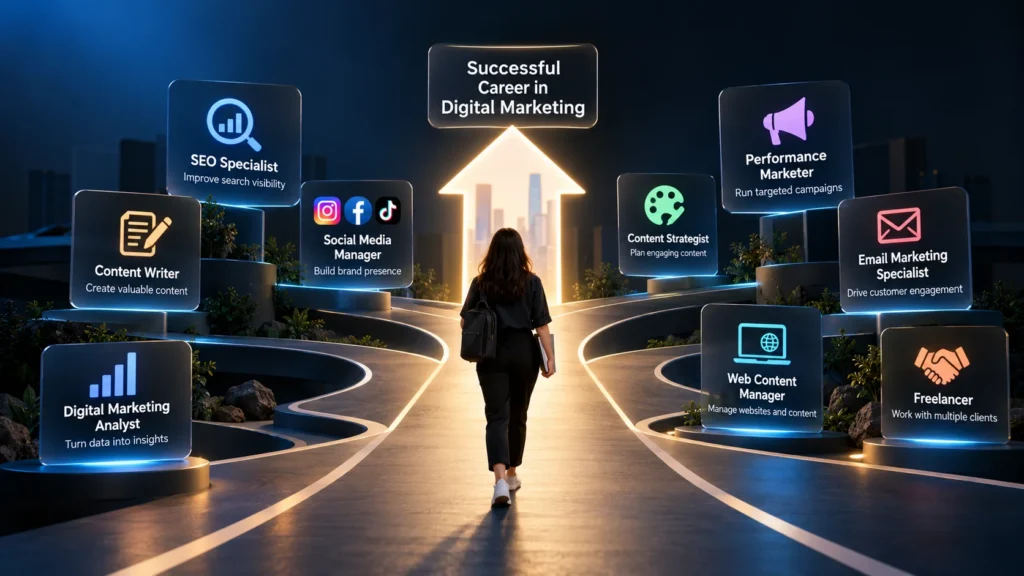
Career Opportunities in Digital Marketing include roles in SEO, social media, content creation, paid advertising, analytics, and freelancing.
The internet has transformed the way businesses promote their products, communicate with customers, and build their brands. People now rely on digital channels in different ways, from searching online for answers and discovering brands on social media to comparing products through websites and checking customer feedback before choosing a service. Because of these changes, digital marketing has become an important part of business development across different industries.
Digital marketing is the practice of building brand awareness and promoting business offerings through internet-based platforms. It covers activities such as improving search visibility, managing social media, producing digital content, running online advertisements, sending email campaigns, developing websites, and evaluating marketing data. When these methods are used effectively, businesses can connect with relevant audiences, highlight what makes their offerings valuable, attract prospective customers, and maintain relationships that encourage future engagement.
One of the most attractive features of digital marketing is the variety of career opportunities available. People who enjoy writing can explore content marketing, while individuals interested in creativity and communication may prefer social media marketing. Those who enjoy research, numbers, and problem-solving can consider SEO, performance marketing, or analytics. There are also opportunities for people who want to work with established companies, join marketing agencies, work remotely, or provide freelance services to different clients.
Digital marketing is not limited to large companies or technology businesses. Educational institutions, restaurants, healthcare providers, clothing stores, real estate companies, travel businesses, and local service providers can all benefit from an effective online presence. This creates opportunities for professionals with different educational backgrounds and levels of experience.
However, building a successful career requires more than understanding social media platforms or knowing how to create advertisements. Digital marketers must understand customer behavior, develop suitable strategies, create valuable content, measure campaign performance, and adapt to changing technologies.
This guide to Career Opportunities in Digital Marketing explores the major professional pathways, the skills required for different positions, salary expectations in India, freelancing possibilities, the importance of artificial intelligence, and practical steps beginners can follow to build a career in this industry.
Table of Contents
Toggle1. What Is Digital Marketing and How Does It Create Career Opportunities?
Digital marketing is the process of promoting a business, product, service, or personal brand through digital communication channels.Digital marketing uses various online platforms to promote a business, such as search tools, company websites, social networks, email campaigns, paid promotional spaces, and other digital communication channels.
Traditional marketing methods often rely on newspapers, television, radio, brochures, and printed advertisements. By using internet-based platforms, businesses can interact with their target customers and evaluate how well their promotional activities perform through measurable results and campaign data.
For example, a clothing business can publish product photographs on Instagram, improve its website so that customers can find it through search engines, and run advertisements to promote a seasonal sale. An educational institution can publish informative articles, share student success stories, and advertise courses to people interested in further education.
These activities serve different purposes, but they can support the same business objective. A business can use social platforms to increase brand awareness, improve its website’s visibility through search engine optimization, and send emails to stay connected with people who have shown interest in its products or services.
Businesses can also track the outcomes of their online promotional efforts to understand what is working well and where improvements may be needed. Marketers can examine website visits, advertisement clicks, enquiries, purchases, and other relevant measurements. This information helps them understand what is working and where improvements may be necessary.
The field combines creativity, communication, technology, and business strategy. Professionals need to understand their target audience, select suitable channels, develop relevant messages, and evaluate whether their work contributes to business goals.
Because different businesses have different audiences and objectives, Digital Marketing Career Opportunities span several specializations rather than one standard career path.
2. Why Choose a Career in Digital Marketing?
Digital marketing can be an attractive career option for people who want to work in a field that combines creativity, technology, and business development. Its advantages depend on the particular role, employer, and individual’s interests, but several features make it worth exploring.
2.1 A Wide Range of Digital Marketing Career Opportunities
Career Opportunities in Digital Marketing include numerous specializations. This allows individuals to choose a role that matches their strengths instead of following one fixed career path.
Someone who enjoys writing may become a content writer or content strategist. Someone who enjoys helping websites attract more visitors from search results can choose search engine optimization (SEO) as their area of specialization. Someone who enjoys analyzing numbers and testing different approaches may prefer performance marketing or paid advertising.
These specializations also create opportunities for career changes within the industry. A social media executive may develop an interest in content strategy, while an SEO specialist may move toward analytics or digital marketing management.
2.2 Opportunities Across Different Industries
Almost every business that wants to reach customers online can benefit from digital marketing. This includes retail, education, healthcare, hospitality, technology, entertainment, finance, and professional services.
Gaining experience across various industries enables digital marketers to learn how customer preferences differ and how businesses handle their unique marketing needs.
For example, a restaurant may need local search visibility and engaging social media content, while an online education company may focus on generating enquiries through advertisements and informative website pages. An e-commerce business may prioritize product visibility, online sales, and customer retention.
This variety allows professionals to explore industries that match their interests.
2.3 Digital Marketing Career for Freshers and Graduates
A Digital Marketing Career for Freshers can begin with entry-level positions for people who are still developing their professional experience. Depending on the employer, beginners may find opportunities as interns, trainees, junior executives, content writers, or SEO assistants.
You do not necessarily need a formal marketing qualification to enter the digital marketing field, as practical skills and relevant experience can also help you build a career. Employers may also consider practical knowledge, communication skills, relevant projects, and the ability to learn.
However, requirements vary. Some roles require technical knowledge or previous experience, so beginners should carefully review job descriptions before applying.
2.4 Freelancing and Remote Work Possibilities
Many digital marketing tasks can be completed online, making remote work and freelancing possible in certain roles. These flexible arrangements expand Digital Marketing Career Opportunities beyond traditional office positions.
Freelancers may help businesses manage social media, improve website content, conduct SEO research, create marketing materials, or manage advertising campaigns. They can work with clients in different locations if communication, contracts, and project requirements allow it.
Freelancing offers flexibility, but it also involves finding clients, negotiating fees, managing deadlines, and maintaining consistent service quality. Income may vary, particularly when starting out.
2.5 Continuous Learning and Professional Development
Digital marketing changes as online platforms, customer expectations, and technologies evolve. New tools and campaign formats create opportunities for professionals to develop additional skills.
Continuous learning can help marketers improve their work, adapt to industry changes, and qualify for more advanced responsibilities.
Professionals who stay curious and regularly practise their skills may find it easier to identify new opportunities and develop specialized expertise.
2.6 A Combination of Creativity and Strategy
Digital marketing is not only about producing creative content. It also involves understanding why a particular message is suitable for an audience and how it supports business objectives.
A social media marketer may create an engaging campaign concept and then evaluate whether it generates relevant enquiries. A content marketer may write an informative article and review whether it attracts organic traffic.
This combination makes digital marketing suitable for people who enjoy creative work as well as practical problem-solving.
3. Major Career Opportunities in Digital Marketing
Career Opportunities in Digital Marketing cover many professional roles. Some focus on one marketing channel, while others combine several activities or manage complete campaigns.
3.1 SEO Specialist: A Digital Marketing Career Path
A Search Engine Optimization (SEO) specialist helps websites improve their visibility in organic search engine results. Organic results are unpaid listings that appear when people search for information, products, or services.
The main objective of SEO is to help search engines understand website content while providing visitors with relevant and useful information.
SEO specialists research keywords, study search intent, improve website content, review technical issues, and monitor organic search performance.
Their responsibilities may include:
- Researching relevant keywords and search topics.
- On-page SEO includes updating a webpage’s titles, search snippets, headings, and main text to make its topic clearer to search engines and help it appear for relevant searches.
- Reviewing website structure, mobile usability, and indexing.
- Improving internal links and identifying technical issues.
- Evaluating competitors and identifying content opportunities.
- Monitoring organic traffic and search performance.
- Preparing reports and recommending improvements.
For example, a local interior design business may want its website to appear when potential customers search for interior design services in its area. An SEO specialist can improve the website’s service pages, research relevant keywords, organize content, and address technical problems.
SEO specialists may use Google Search Console, Google Analytics, keyword research platforms, and website auditing tools.
Among Digital Marketing Career Opportunities, this specialization suits people who enjoy research, writing, analysis, and problem-solving. With experience, professionals may progress into senior SEO, technical SEO, SEO strategy, or SEO management roles.
3.2 Social Media Marketing Career Opportunities
A social media marketing specialist helps businesses communicate with their audiences through platforms such as Instagram, Facebook, LinkedIn, and YouTube.
The role involves planning content, maintaining brand consistency, engaging with relevant audiences, and evaluating campaign performance.
Responsibilities may include developing content calendars, writing captions, preparing creative briefs, coordinating graphics and videos, scheduling posts, and reviewing analytics.
For example, a local café may use Instagram to showcase its menu, introduce new products, announce offers, and encourage customers to visit. A social media marketer plans these activities according to the café’s audience, brand identity, and business objectives.
Social media professionals must understand that every platform has different features and audience expectations. Content that works well on one platform may need to be adapted for another.
Useful skills include communication, creativity, content planning, basic design knowledge, and performance reporting.
This role can lead to opportunities in social media management, content strategy, brand marketing, or integrated digital marketing. It is one of several Career Opportunities in Digital Marketing for creative communicators.
3.3 Content Marketing Career Opportunities
A content marketing specialist develops useful information that attracts an audience and supports business goals.
Content can include blog articles, website pages, newsletters, case studies, videos, guides, and social media posts. Its purpose may be to answer customer questions, explain a product, build trust, or help people make informed decisions.
For example, an educational company may publish articles explaining career options, course requirements, and learning methods. This content can help prospective students understand their choices before contacting the institution.
Content marketers research topics, understand audience needs, prepare editorial calendars, write and edit content, coordinate creative work, and evaluate performance.
They must focus on quality and relevance rather than simply publishing a large number of articles. Useful content should provide accurate information, answer meaningful questions, and communicate clearly.
Strong writing, research, editing, storytelling, and SEO knowledge can be valuable in this role.
Digital Marketing Career Opportunities in content include content writer, copywriter, editorial specialist, content strategist, and content marketing manager.
3.4 Pay-Per-Click and Paid Advertising Specialist
A pay-per-click (PPC) specialist manages paid advertising campaigns, often through platforms such as Google Ads and Meta Ads.
These professionals help businesses reach selected audiences and encourage actions such as website visits, enquiries, registrations, or purchases.
Their responsibilities include researching keywords, selecting audience segments, writing advertisements, coordinating creative materials, setting budgets, monitoring performance, and optimizing campaigns.
For example, a training institute may advertise a new course to generate enquiries from people interested in professional development. The PPC specialist must consider the audience, advertisement message, landing page, budget, and quality of the enquiries generated.
Important measurements may include cost per click, conversion rate, cost per lead, and campaign return.
Paid advertising specialists need to understand targeting, bidding, campaign objectives, conversion tracking, and budget management.
Career progression may include paid media specialist, paid advertising manager, or performance marketing strategist.
3.5 Performance Marketing Specialist
Performance marketing focuses on measurable business outcomes. These outcomes may include purchases, qualified leads, registrations, app installations, or other valuable customer actions.
Performance marketers evaluate campaign data to understand which audiences, channels, advertisements, and messages contribute to business objectives.
For example, an online store might receive many advertisement clicks but generate relatively few purchases. A performance marketer can investigate audience quality, product pricing, website usability, and checkout difficulties before recommending changes.
Common measurements include conversion rate, customer acquisition cost, cost per acquisition, and return on ad spend.
This role combines advertising knowledge, analytical thinking, experimentation, and business understanding. Professionals must recognize that generating traffic does not automatically mean generating profitable results.
With experience, performance marketers may progress into growth marketing, customer acquisition management, or digital growth leadership.
3.6 Email Marketing Specialist
Professionals in email marketing create and send targeted messages to people who have subscribed to a business’s mailing list or previously interacted with the brand. Their work may include newsletters, product announcements, welcome messages, promotional campaigns, and automated follow-up sequences.
For example, an online store may send updates about new collections to customers who have agreed to receive marketing emails. An educational company may send helpful information to prospective students who have subscribed to its communications.
Email marketers develop campaign plans, write content, organize subscriber lists, create audience segments, test different approaches, and measure performance.
Doing well in email marketing requires creating relevant content, recognizing subscriber interests, organizing campaigns effectively, and using email software to send messages and assess their performance.
Privacy and consent are also important. Businesses should communicate appropriately with subscribers and respect their preferences.
Career opportunities include email marketing specialist, lifecycle marketer, customer retention specialist, and marketing automation professional.
3.7 Web Analytics and Digital Marketing Career Opportunities
A web analytics specialist studies how people interact with websites, applications, and digital marketing campaigns.
They analyze website activity to identify traffic sources, understand how visitors interact with different pages, track completed actions, and discover the points where users leave without taking the next step.
For instance, an advertisement might bring many visitors to a business website, yet only a small number of them may contact the company or request more information. An analytics specialist can examine visitor behavior, conversion tracking, and the customer journey to identify possible problems.
Responsibilities include configuring measurement systems, monitoring website activity, preparing reports, analyzing traffic sources, and identifying opportunities for improvement.
Relevant skills include data interpretation, spreadsheets, analytics tools, and clear reporting. Some advanced roles may require knowledge of SQL, tag management, or data visualization.
Professionals can progress into marketing analytics, measurement strategy, or conversion optimization.
3.8 Conversion Rate Optimization Specialist
Conversion rate optimization (CRO) aims to make web pages more effective at turning visitors into customers or leads by making it easier for them to complete actions like ordering a product, submitting their details, or registering for an offer.
A conversion might involve submitting a contact form, purchasing a product, registering for a webinar, or subscribing to a service.
CRO specialists review website navigation, landing pages, forms, product descriptions, calls to action, and checkout processes. They use data, customer feedback, and testing to identify possible improvements.
For instance, shoppers may leave an online store if placing an order involves too many confusing steps. Making the checkout process clearer and easier to complete can encourage more visitors to finish their purchases.
CRO requires analytical thinking, user experience knowledge, research skills, and an understanding of customer behavior.
This specialization can lead to opportunities in growth optimization, experimentation, and digital experience strategy.
3.9 Influencer Marketing Specialist
Influencer marketing professionals connect businesses with online creators whose followers are likely to be interested in the brand’s products or services.
Their work includes identifying suitable creators, reviewing audience relevance, discussing campaign requirements, coordinating content, managing timelines, and evaluating results.
For example, a skincare brand may collaborate with beauty creators who regularly share skincare information with an audience interested in those products.
When selecting an influencer to work with a brand, marketers should also consider audience relevance, engagement levels, content quality, and how well the creator aligns with the brand’s values. Audience relevance, engagement quality, content style, brand alignment, and campaign objectives are also important.
Professionals must understand disclosure requirements, usage rights, agreements, and accurate promotional communication.
Career opportunities include influencer marketing management, creator partnerships, and brand collaboration strategy.
3.10 Affiliate Marketing Manager
Affiliate marketing involves partnerships in which publishers, content creators, or other partners promote products or services in exchange for agreed compensation.
Compensation may depend on completed sales, qualified leads, or other specified actions.
An affiliate marketing manager recruits suitable partners, explains program requirements, tracks referrals, reviews performance, and maintains relationships.
For example, an educational website may recommend relevant learning resources through tracked links as part of an affiliate program.
This role requires communication, relationship management, analytical thinking, and an understanding of promotional policies.
As they gain experience, marketers can progress to roles that oversee brand collaborations, manage affiliate initiatives, or lead strategies for attracting new customers through digital channels.
3.11 Digital Marketing Executive
A digital marketing executive is a common entry-level role for people who want to gain experience across different marketing channels.
Depending on the employer, responsibilities may include social media management, content preparation, basic SEO, advertising support, website updates, and campaign reporting.
For example, an executive working for a small business might help prepare social media posts, update website information, research keywords, and organize monthly marketing reports.
This position provides exposure to practical marketing activities and helps beginners understand how different channels work together. It is a useful option when exploring a Digital Marketing Career for Freshers.
It can be a useful starting point before specializing in SEO, social media, content marketing, or paid advertising.
3.12 Digital Marketing Manager
A digital marketing manager oversees marketing activities and ensures that campaigns support the organization’s business objectives.
Responsibilities may include planning strategies, allocating budgets, coordinating teams, evaluating campaign performance, and communicating results to senior management.
Managers often work with specialists responsible for SEO, advertising, content, social media, and analytics. In smaller businesses, they may also complete campaign tasks directly.
Being effective in this role requires the ability to guide a team, share ideas clearly, organize projects, and use data to make informed decisions.
This position usually requires practical experience and an understanding of how marketing activities contribute to leads, sales, customer relationships, and business growth.
Career progression may include head of digital marketing, marketing director, or growth leadership.
3.13 E-commerce Marketing Specialist
E-commerce marketing specialists help online stores attract customers, improve product visibility, and increase purchases.
Their responsibilities may include product page optimization, shopping advertisements, promotional campaigns, email marketing, customer retention, and conversion optimization.
For example, an online clothing store may need better product descriptions, relevant search visibility, improved product images, and a smoother checkout process.
E-commerce marketers coordinate these activities while reviewing customer behavior and sales performance.
Useful skills include SEO, paid advertising, product presentation, analytics, and an understanding of online shopping behavior.
Experienced professionals may progress into e-commerce management or digital commerce strategy.
3.14 Marketing Automation Specialist
Marketing automation specialists use software to organize repetitive marketing tasks and deliver appropriate communication at different stages of the customer journey.
Automation can include welcome emails, lead follow-ups, customer segmentation, reminder messages, and notifications for important customer actions.
For example, someone who subscribes to an educational newsletter may receive a series of relevant emails explaining useful learning resources and available courses.
Automation specialists plan workflows, organize customer information, test automated journeys, and monitor performance.
This role requires logical thinking, attention to detail, communication skills, and familiarity with marketing automation or customer relationship management platforms.
Career opportunities include marketing operations, lifecycle marketing, and customer engagement strategy.
3.15 Digital Marketing Consultant
A digital marketing consultant helps businesses understand their marketing challenges and develop suitable strategies.
Consultants may review websites, assess SEO performance, evaluate social media activities, analyze advertising campaigns, and recommend improvements.
For example, a local business may want to increase online enquiries but may not know which marketing channels deserve priority. A consultant can examine its audience, competitors, website, and existing activities before suggesting a practical plan.
Consultants need industry knowledge, communication skills, analytical thinking, and the ability to explain recommendations clearly.
This career can suit experienced professionals who enjoy strategy, client relationships, and independent work. Building credibility generally requires practical experience, reliable case studies, and a clear understanding of the services offered.
4. Digital Marketing Career for Freshers: Entry-Level Opportunities
A Digital Marketing Career for Freshers can offer entry-level opportunities for graduates and people who are still developing their professional experience.
Common starting positions include digital marketing intern, SEO trainee, social media executive, content writer, PPC assistant, and junior digital marketing executive.
These positions may involve assisting experienced marketers, preparing content, conducting research, coordinating campaigns, and learning how to use marketing tools.
When planning a Digital Marketing Career for Freshers, beginners should not assume that they must master every specialization before applying for jobs. A basic understanding of the industry and relevant practical skills can provide a starting point.
One useful approach is to build a small portfolio of practice projects. A beginner interested in SEO can prepare a sample keyword research report. Someone interested in social media can develop a content calendar for a fictional business. A person interested in paid advertising can prepare a sample campaign plan without spending money.
These projects help demonstrate the ability to apply concepts to realistic situations.
When presenting a portfolio, clearly identify practice projects and distinguish them from work completed for real clients. Employers should be able to understand what you created, what skills you used, and what you learned.
Freshers can also improve their opportunities by developing communication skills, learning basic reporting, and understanding how marketing activities connect with business objectives. These abilities help candidates prepare for Digital Marketing Career Opportunities across different industries.
5. Digital Marketing Career Opportunities for Graduates
Digital marketing attracts graduates from different academic backgrounds because the industry combines business, communication, creativity, and technology.
Business administration graduates may find their knowledge of management, customers, and business objectives useful when planning campaigns or coordinating marketing activities.
Graduates in English, journalism, and communications may be interested in content writing, copywriting, editorial work, or content strategy.
People with technical backgrounds may explore technical SEO, website optimization, analytics implementation, or marketing automation.
Design graduates may consider visual content creation, creative strategy, advertising design, and brand communication.
Individuals who enjoy mathematics, statistics, or data analysis may prefer performance marketing, marketing analytics, or campaign measurement.
These Career Opportunities in Digital Marketing are possible pathways rather than strict rules. Your degree does not determine the only career you can pursue. Practical skills, relevant projects, communication, and continuous learning can help you move into different areas of digital marketing.
6. Essential Skills for a Digital Marketing Career
Building a career requires more than familiarity with online platforms. Exploring Digital Marketing Career Opportunities becomes easier when you develop a combination of technical and communication skills. Professionals need technical, creative, analytical, and interpersonal skills.
SEO Skills for a Digital Marketing Career
Understanding keywords, search intent, website structure, and content optimization helps marketers improve online visibility. Even professionals who do not specialize in SEO can benefit from knowing how search engines influence customer discovery.
Content Creation and Copywriting
Clear writing is useful for website pages, advertisements, social media captions, and blog articles. Marketers need to communicate ideas in a way that matches the audience and supports the intended objective.
Social Media Knowledge
Professionals should understand relevant platforms, content formats, audience behavior, and performance reporting. They must also adapt as platform features and audience preferences change.
Data Analysis
Campaign data can reveal patterns in website traffic, engagement, conversions, and sales. Marketers should learn to interpret these measurements and explain what they mean for business decisions.
Paid Advertising Knowledge
Understanding targeting, budgets, bidding, advertisement quality, and conversion tracking is useful for people interested in paid media.
Website Fundamentals
Knowledge of WordPress, landing pages, mobile usability, and website structure can help marketers manage content and identify basic problems.
Communication and Teamwork
Digital marketers frequently work with designers, developers, clients, sales teams, and business owners. Clear communication helps teams coordinate tasks and maintain realistic expectations.
Creativity and Problem-Solving
Creativity helps marketers generate ideas, while problem-solving helps them investigate weak results and decide which improvements to test.
Time Management
Marketing professionals often manage multiple campaigns and deadlines. Organizing tasks and prioritizing important work helps maintain quality.
Adaptability
Digital marketing changes continuously. Professionals who remain willing to learn new tools, evaluate new methods, and update their knowledge are better prepared to respond to industry developments.
7. Important Tools for Digital Marketing Career Development
Marketing tools help professionals plan campaigns, measure performance, organize content, and manage websites.
| Tool | Main purpose |
|---|---|
| Google Analytics 4 | Measuring website activity and conversions |
| Google Search Console | Monitoring organic search performance |
| Google Ads | Managing paid advertising campaigns |
| Meta Ads Manager | Managing advertising across supported Meta placements |
| Google Keyword Planner | Researching keyword ideas |
| WordPress | Managing website content |
| Canva | Creating marketing graphics |
| Google Sheets | Organizing data, calendars, and reports |
| Email marketing platforms | Managing email communication and automation |
| Tag management tools | Organizing website tracking configurations |
For a Digital Marketing Career for Freshers, beginners do not need to master every tool at once. Someone interested in SEO can begin with Google Search Console, keyword research, and website optimization. A person interested in social media can start with content planning, basic design, and platform analytics.
It is also important to understand why a tool is being used. Software can support a decision, but it cannot automatically determine the best marketing strategy for every business.
8. Digital Marketing Career Salary in India
Salary is an important factor when choosing a career, but earnings vary according to location, experience, specialization, company size, and job responsibilities.
The following figures are illustrative planning ranges rather than verified current salary averages or guaranteed job offers.
| Experience level | Illustrative annual salary |
|---|---|
| Intern or trainee | ₹60,000–₹1.8 lakh |
| Fresher or junior executive | ₹1.8–₹3.6 lakh |
| Experienced specialist | ₹3–₹7 lakh |
| Senior specialist or team lead | ₹6–₹12 lakh |
| Experienced manager or strategist | ₹8–₹18 lakh or more |
Actual salaries can fall outside these ranges. Compensation may differ between smaller-city employers, agencies, large companies, and specialized technology businesses.
Specialization can influence earning potential across Career Opportunities in Digital Marketing. Professionals who can manage advertising budgets, solve technical SEO problems, implement analytics, or connect marketing activity with business results may qualify for different opportunities as their experience grows.
However, a higher salary is not guaranteed simply because someone chooses a particular specialization. Employers also consider practical ability, communication, experience, and the value a person can contribute.
When evaluating a job offer, consider the responsibilities, learning opportunities, work environment, career progression, and compensation together.
9. Freelancing and Digital Marketing Career Opportunities
Freelancing is one of the flexible Digital Marketing Career Opportunities, allowing professionals to provide marketing services independently rather than working exclusively as employees.
Freelancers may work with local businesses, startups, online stores, individual professionals, or organizations that need specific marketing support.
Social Media Management
Freelancers can prepare content calendars, write captions, coordinate graphics, schedule posts, and evaluate performance.
Before accepting a project, they should clarify which platforms are included, how many posts are required, how revisions work, and whether customer messages are part of the service.
SEO Services
Freelance SEO professionals may provide keyword research, on-page optimization, technical reviews, local SEO support, and content recommendations.
They should communicate realistic expectations because SEO results depend on competition, website quality, content relevance, and other factors.
Content Writing
Freelance writers create blog articles, website pages, service descriptions, product descriptions, and email content.
Understanding the client’s audience, brand voice, factual requirements, and objectives helps produce more useful content.
Website Development and Optimization
Professionals with suitable technical skills can create or update WordPress websites, improve landing pages, organize content, and address basic website issues.
They should describe their capabilities honestly and avoid accepting technical work they cannot complete reliably.
Paid Advertising Management
Experienced freelancers may manage advertising campaigns, prepare campaign plans, review tracking, and provide performance reports.
Advertising expenditure and management fees should be clearly explained so clients understand how their money is being used.
How to Build a Freelance Digital Marketing Career
Start by choosing one or two services that match your current skills. Prepare sample projects, create a professional portfolio, and identify businesses that could benefit from your services.
Contact potential clients with personalized proposals explaining the problem you can help address. Avoid sending generic messages that make unrealistic promises.
Before starting work, agree on deliverables, deadlines, fees, payment terms, and reporting arrangements.
Freelancing can provide flexibility and exposure to different industries, but finding clients and maintaining consistent income takes time. Professional communication, reliable delivery, and honest reporting help build long-term relationships.
10. How to Start a Digital Marketing Career From Scratch
Starting a Digital Marketing Career for Freshers without experience can feel challenging, especially when job descriptions request practical knowledge. A structured approach can help you develop the skills needed for entry-level opportunities.
Step 1: Learn Digital Marketing Fundamentals
Start by learning the basics of search optimization, social media promotion, content creation, online advertising, email campaigns, and marketing data analysis.
Learn how these channels support different business objectives and how customers move from discovering a brand to considering and purchasing its products.
Step 2: Choose a Specialization
Trying to master every area at once can be overwhelming. Choose a starting point based on your interests.
If writing is one of your strengths, you could consider a career in content marketing or search engine optimization, where creating useful content plays an important role. If you enjoy visual communication, try social media marketing. If you prefer data and experimentation, learn about paid advertising or analytics.
Step 3: Use Reliable Learning Resources
Study structured courses, official platform documentation, and practical tutorials. Google Skillshop and official analytics learning resources can help you understand relevant tools and concepts.
Certificates may demonstrate learning, but they do not automatically prove that you can manage a campaign. Combine your studies with practical work.
Step 4: Create Practice Projects
Apply your knowledge to realistic examples.
You could create a social media calendar for a fictional café, prepare keyword research for a sample website, write an SEO-friendly article, or develop a paid advertising plan for an imaginary product.
Practice projects allow you to test your knowledge without requiring a large budget.
Step 5: Build a Digital Marketing Career Portfolio
A portfolio is a collection of work that demonstrates your skills and approach.
Include relevant projects, explain their objectives, describe the steps you took, and identify the skills you used. If you have genuine performance results, present them with appropriate context.
Clearly label sample projects and never invent clients or statistics.
Step 6: Learn Basic Reporting
Understand how to measure whether a campaign supports its objective.
For example, a brand awareness campaign may focus on reach and relevant audience engagement, while a lead-generation campaign may focus on qualified enquiries and cost per lead.
Learning to explain results clearly can help you demonstrate practical understanding during interviews.
Step 7: Apply for Entry-Level Positions
For a Digital Marketing Career for Freshers, look for internships, trainee roles, and junior digital marketing jobs. Tailor your resume and portfolio to each position instead of sending the same application everywhere.
Be prepared to explain your projects, your reasoning, and what you would do if a campaign did not perform as expected.
Step 8: Learn From Feedback
Feedback from employers, mentors, clients, and practice projects can reveal where you need to improve.
You may need stronger writing samples, better technical knowledge, more experience with analytics, or clearer explanations of your work.
Regular hands-on experience and an open attitude toward learning can strengthen your abilities and help you grow professionally.
11. How AI Is Changing Digital Marketing Career Opportunities
Artificial intelligence is changing how marketers research information, develop ideas, analyze data, and organize repetitive tasks. As a result, Digital Marketing Career Opportunities increasingly involve evaluating AI-assisted work alongside traditional marketing skills.
AI tools can help generate content outlines, suggest campaign ideas, summarize information, identify patterns, and support reporting workflows.
For example, a content marketer may use AI to brainstorm article topics before conducting independent research. An advertising specialist may use automated features to support campaign optimization. A marketing analyst may use AI-assisted tools to explore patterns in a dataset.
However, AI-generated content can contain incorrect information, generic wording, or material that does not reflect a particular brand’s needs.
Marketers must review the accuracy, relevance, and quality of AI-assisted work. They should also respect privacy, protect confidential information, and check applicable copyright and platform requirements.
Businesses still need professionals who understand customers, establish objectives, evaluate results, and make strategic decisions.
The most useful approach is to treat AI as a supporting tool rather than a replacement for marketing knowledge. Marketers who understand core marketing principles and use new technologies thoughtfully can adapt more easily as the industry evolves.
12. Common Challenges in a Digital Marketing Career
Although digital marketing offers several opportunities, it also involves challenges that beginners should understand.
Frequent Platform Changes
Search engines, social media platforms, and advertising systems regularly update their features and policies. Marketers must keep learning and avoid depending entirely on outdated techniques.
Competition for Jobs
Entry-level positions may attract many applicants, especially those beginning a Digital Marketing Career for Freshers. Relevant projects, practical skills, and clear communication can help candidates demonstrate their abilities.
Pressure to Demonstrate Results
Businesses often expect improvements in leads, sales, or engagement. However, these outcomes can also depend on pricing, competition, customer service, and product quality.
Marketers should evaluate performance carefully and communicate honestly about the factors influencing results.
Managing Multiple Responsibilities
Some positions involve content, advertisements, reporting, and campaign coordination simultaneously. Time management and clear priorities help maintain quality.
Unpredictable Campaign Performance
SEO takes time, paid advertisements can lose money, and social media posts do not always reach a large audience.
A successful professional needs patience, realistic expectations, and a willingness to learn from disappointing results.
Understanding these challenges helps beginners develop a more realistic view of the industry and prepare for long-term career development.
13. Future Scope and Career Opportunities in Digital Marketing
Digital marketing is likely to remain an important part of business communication as people continue to use online channels to research, compare, and purchase products and services.
Future Career Opportunities in Digital Marketing will depend on how technology, customer behavior, and business requirements develop.
AI and Marketing Automation Career Opportunities
Businesses are adopting tools that support content workflows, research, reporting, and campaign management. People who know how to use marketing software and assess its results can pursue roles focused on campaign management, workflow automation, and improving marketing processes.
Growing Demand for Digital Marketing Analytics Skills
Businesses increasingly need to understand whether marketing activities contribute to meaningful results. This creates opportunities for people who can interpret data, measure conversions, and explain findings clearly.
Demand for Useful Content
Customers want relevant information that answers their questions and helps them make decisions. Businesses can benefit from accurate, informative content that demonstrates an understanding of audience needs.
Content professionals who combine research, communication, and marketing strategy may find opportunities across websites, email, and social media.
Local Search and Location-Based Marketing
Many businesses need to reach customers in specific areas. Local SEO, location-focused content, business profile management, and online reputation management can support these objectives.
Professionals who understand local markets can work with small businesses as well as larger organizations.
Integrated Marketing Strategies
Businesses often combine SEO, social media, email, content, and paid advertising rather than relying on one channel alone.
Marketers who understand how these activities support different stages of the customer journey may be well suited to strategy and campaign management roles.
Customer Experience and Retention
Marketing extends beyond attracting visitors. Website usability, helpful communication, reliable service, and a smooth purchasing experience influence customer decisions.
This creates opportunities for professionals who can connect marketing activities with the overall customer experience.
The future of digital marketing will depend not only on new tools but also on professionals’ ability to understand customers, solve problems, communicate effectively, and adapt to change.
14. How to Choose the Right Digital Marketing Career Path
Choosing among Digital Marketing Career Opportunities becomes easier when you understand your interests, strengths, and preferred working style.
If you enjoy writing and research, content marketing or SEO may be a suitable starting point. These roles involve understanding audience needs, organizing information, and creating useful content.
If you enjoy creativity, visual communication, and online communities, social media marketing may be worth exploring. It offers opportunities to develop content plans, campaign concepts, and engagement strategies.
If you prefer numbers, testing, and performance measurement, consider paid advertising, performance marketing, or analytics.
If you enjoy organizing processes and customer communication, email marketing or marketing automation may suit your interests.
A digital marketing executive role can also provide exposure to several channels before you decide which specialization to pursue.
You can explore different areas of digital marketing early in your career and choose a specialization as your interests and skills develop. Start with one area, complete practical projects, and observe which activities interest you most.
Consider your learning opportunities, local job market, long-term goals, and the skills you want to develop. Choosing a role that supports professional growth can be more valuable than focusing only on its potential salary.
Conclusion: Building a Career in Digital Marketing
Digital marketing offers a wide range of career opportunities for people with different interests, educational backgrounds, and professional goals. From SEO and social media marketing to content creation, paid advertising, analytics, and digital strategy, the industry provides several ways to develop valuable professional skills.
A Digital Marketing Career for Freshers can begin with internships, trainee positions, and practical projects. Graduates can build on their existing strengths, while experienced professionals may progress into management, consulting, performance strategy, or freelancing.
However, a successful digital marketing career requires more than familiarity with online platforms. Professionals need to understand business objectives, communicate clearly, analyze performance, solve problems, and adapt to changing technologies.
The best way to explore Career Opportunities in Digital Marketing is to choose a specialization, learn its fundamentals, practise with realistic projects, and build a portfolio that demonstrates your abilities. As your experience grows, you can expand your knowledge, explore related fields, and take on more advanced responsibilities.
Digital marketing can be a rewarding career for people who enjoy creativity, strategy, technology, and continuous learning. By developing practical skills, staying curious, and learning from experience, you can build a strong foundation for your professional future.
The first step does not have to be complicated. Start learning, create something useful, review your progress, and continue improving. Every project can help you understand the industry more deeply and prepare you for new career opportunities.