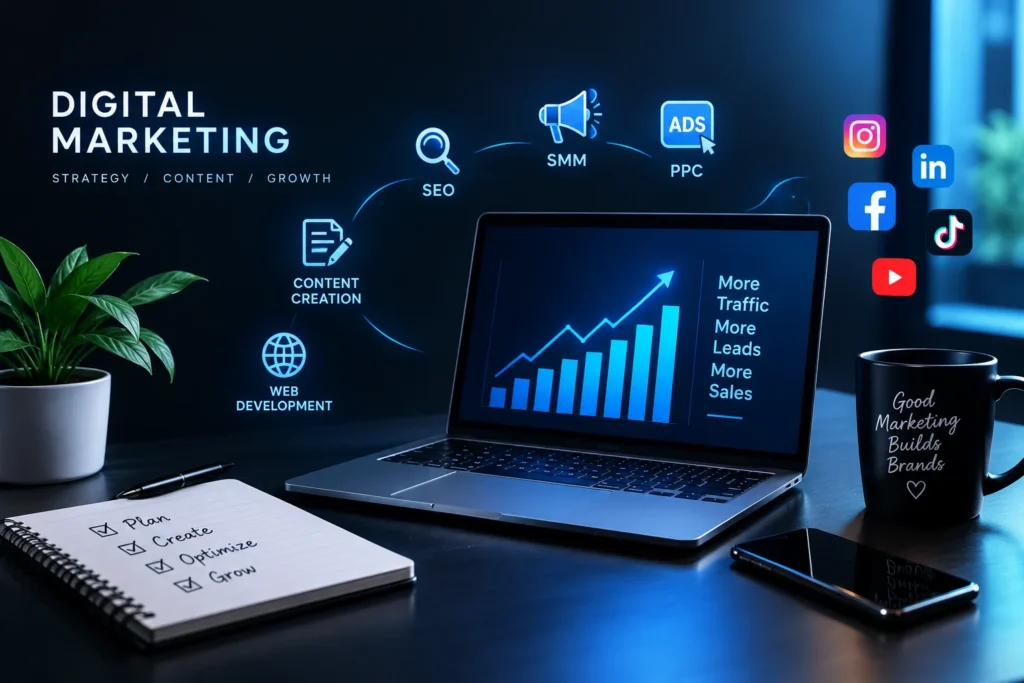
Introduction to Digital Marketing
The way people discover businesses, compare products, and make purchasing decisions has changed significantly with the growth of the internet. Before choosing a product or service, many consumers turn to the internet to explore their options and learn more about available businesses. They use search engines to find information, social media platforms to discover brands, websites to compare options, and online reviews to decide which business they can trust. For this reason, building a strong digital presence is now essential for businesses that want to expand and succeed in a competitive market.
Digital marketing involves using online platforms and digital technologies to promote a business, its products, or its services. These channels include websites, search engines, social media, email campaigns, and digital advertisements. Through these methods, businesses can reach the right audience, highlight what makes their offerings valuable, develop customer trust, and motivate people to engage or make a purchase. Businesses can use online platforms to track the response to their marketing activities, learn what their audience prefers, and adjust their promotional plans based on the results they observe.
Digital marketing enables businesses of all sizes to connect with suitable customers, whether they focus on a nearby community or aim to expand their reach into international markets. Small businesses can use it to compete with larger brands, while established companies can strengthen their market position and explore new opportunities. However, achieving meaningful results requires more than simply creating social media accounts or publishing advertisements. To achieve good results, businesses should develop a well-defined marketing plan, share valuable content, maintain regular communication with their audience, and understand their customers’ needs and preferences.
Digital marketing combines creativity, technology, communication, and analysis. It involves identifying customer needs, selecting appropriate platforms, developing relevant messages, and evaluating how effectively those messages support business objectives. When these activities work together, digital marketing becomes a valuable tool for building long-term business growth.
This guide explains the meaning of digital marketing, its importance, its major types, the strategies businesses can use, the tools that support marketing activities, and the future opportunities available in the digital world.
What Is Digital Marketing?
Digital marketing refers to the promotion of a business, product, service, or personal brand through digital platforms and technologies. It includes activities such as improving website visibility on search engines, creating social media content, sending promotional emails, publishing informative articles, and running paid advertising campaigns.
Digital marketing aims to bring businesses and potential customers together by promoting relevant products and services to the right audience. It supports customers throughout their buying journey, from discovering a brand for the first time to comparing options and making a purchase. Someone may first discover a brand through an Instagram post, visit its website after searching on Google, read a blog to understand a service, and finally contact the business through WhatsApp.
Consider a small skincare brand looking for ways to attract more customers and boost sales through its online platforms. The skincare brand could share helpful skincare tips, improve its website so customers can find its products through search engines, partner with beauty influencers, and promote its products through targeted online campaigns. Each activity would support a different part of the marketing process.
Digital marketing is not limited to selling products directly. It can also help businesses increase awareness, educate customers, build credibility, generate enquiries, promote events, and maintain relationships with existing customers.
The first step in creating a strong digital marketing strategy is to define the business’s goals and desired outcomes. For instance, a company aiming to attract more visitors to its website can prioritise search engine optimisation (SEO) and content marketing to improve its visibility and bring in relevant traffic. Businesses looking to attract a larger audience to their websites can use SEO techniques and create informative content to improve their online visibility and draw in potential customers. A business looking for immediate enquiries may use paid search advertising or lead generation campaigns. A brand that wants to strengthen customer relationships may prioritise email marketing and social media engagement.
The most suitable approach depends on the target audience, industry, budget, competition, and available resources.
How Digital Marketing Helps Businesses Grow
Digital marketing has become an important part of modern business because customers increasingly use digital channels to discover information and evaluate their options. By understanding customer behaviour, businesses can identify effective ways to attract potential buyers, strengthen their market position, and compete more successfully with other brands.
1. Reaching the Right Audience
One of the major advantages of digital marketing is the ability to reach people based on their interests, location, search behaviour, demographics, and other relevant characteristics. Rather than targeting everyone with a general advertisement, businesses can create focused marketing campaigns that appeal to audiences whose needs and interests match the products or services they offer.
For instance, a local restaurant can promote its offers to people in nearby areas, while an online clothing store can reach shoppers interested in particular fashion categories. This helps businesses use their marketing resources more effectively.
2. Building Brand Awareness
Customers are more likely to recognise a business when they encounter its name, message, and content consistently across relevant platforms. A professional website, useful blog posts, engaging social media content, and clear brand messaging can help create a recognisable identity.
Building brand recognition is particularly valuable for newly established businesses that want to introduce their products or services and gain visibility among potential customers. By sharing helpful information and communicating consistently, businesses can gradually become familiar to their target audience.
3. Improving Customer Communication
Digital platforms allow businesses to communicate with customers through comments, direct messages, email, contact forms, and messaging applications. People can contact a business through online channels to clarify their doubts, learn more about its offerings, and get assistance from wherever they are.
This direct communication can help businesses understand customer concerns, identify common questions, and improve their services. It also creates opportunities to develop stronger relationships through useful and timely responses.
4. Measuring Marketing Performance
Traditional marketing can sometimes make it difficult to determine exactly how many people responded to a particular campaign. Digital marketing provides tools that help businesses measure website visits, advertisement clicks, enquiries, conversions, and other performance indicators.
By analysing these results, marketers can determine which strategies are performing well and identify aspects of their campaigns that need further improvement. For example, if a website receives visitors but generates very few enquiries, the business can investigate whether the content, contact information, user experience, or offer needs improvement.
5. Supporting Different Budgets
Digital marketing offers opportunities for businesses with different levels of financial resources. A small business can begin with a basic website, organic social media content, local search optimisation, and informative articles. Businesses with larger budgets can add paid advertising, professional content production, advanced analytics, and marketing automation.
However, low-cost marketing does not necessarily mean effortless marketing. Organic activities require time, planning, creativity, and consistency. Paid campaigns also need careful management to avoid unnecessary spending.
6. Expanding Business Opportunities
A business that previously served only customers in its immediate neighbourhood may use digital channels to reach a wider market. Websites, online marketplaces, social media, and targeted campaigns can introduce products and services to new audiences.
The level of expansion depends on the nature of the business, delivery capabilities, competition, and customer demand. Nevertheless, digital marketing can help businesses explore opportunities beyond their existing customer base.
Major Types of Digital Marketing
Digital marketing includes several interconnected methods. Each method serves a particular purpose, and businesses can combine different techniques to create a more complete marketing strategy.
1. Search Engine Optimisation (SEO)
Search engine optimisation, commonly known as SEO, is the process of improving a website so that its pages can be discovered more effectively through search engines such as Google. The goal is to attract relevant organic traffic by making website content useful, accessible, and relevant to what people are searching for.
When users search for information, products, or services, search engines display results based on many factors related to relevance, quality, usability, and other signals. Search engine optimisation (SEO) helps businesses make their websites easier for search engines to interpret while enabling users to discover useful and relevant information online.
SEO generally includes three important areas: on-page SEO, technical SEO, and off-page SEO.
On-page SEO focuses on elements within a website, including page titles, headings, content, internal links, image descriptions, and keyword relevance. A website design company should provide clear descriptions of its services along with helpful details, allowing potential customers to understand the available options and decide which solutions best suit their requirements.
Technical SEOTechnical SEO aims to enhance a website’s underlying structure and performance so search engines can access, crawl, and index its pages more effectively. This may include mobile usability, page loading performance, crawlability, indexing, secure connections, and a logical site structure. A technically accessible website helps search engines discover and process its pages.
Off-page SEO focuses on activities outside the website that can support its credibility and visibility. Building quality backlinks, earning authentic brand mentions, and connecting with trustworthy websites can help strengthen a website’s credibility and improve its reputation online.
Keyword research is a key element of SEO, helping businesses discover the search terms people use to find relevant products, services, and information online. It helps marketers understand the phrases people use when searching for information. A local service provider, for instance, may target relevant searches such as “digital marketing specialist in Malappuram” if that phrase accurately reflects its service and location.
However, adding keywords repeatedly without providing useful information can make content unnatural.Good SEO focuses on providing relevant information, creating easy-to-read content, meeting users’ needs, and delivering a smooth website experience instead of overusing keywords.
SEO usually requires patience because improvements may take time to appear. Its long-term value comes from attracting relevant visitors who are actively searching for information or solutions connected to the business.
2. Search Engine Marketing and Paid Search Advertising
Search engine marketing is commonly used to describe marketing activities that improve a business’s visibility through search engines. In many practical discussions, it particularly refers to paid search advertising, while SEO focuses on organic visibility.
Paid search campaigns allow businesses to display advertisements when people search for selected terms or meet relevant targeting criteria. Platforms such as Google Ads provide tools for creating campaigns, selecting keywords, setting budgets, and measuring results.
For example, a person searching for a nearby web design service may see sponsored results from businesses advertising related services. If the advertisement matches the user’s needs and leads to a relevant landing page, it may generate an enquiry.
Paid search advertising can be useful when a business wants to reach people who are actively looking for a product or service. It also allows marketers to test different messages, offers, and landing pages.
However, advertising costs can increase when competition is high or campaigns are poorly managed. Businesses should monitor search terms, advertisement relevance, conversion rates, and cost per lead instead of focusing only on clicks.
A well-managed paid search campaign connects three important elements: the customer’s search intent, a relevant advertisement, and a landing page that fulfils the advertisement’s promise.
3. Social Media Marketing
Social media marketing uses platforms like Instagram, Facebook, LinkedIn, and YouTube to showcase a business, publish engaging content, interact with its audience, and increase public recognition of the brand.
Social media provides opportunities to present a brand through images, videos, stories, educational posts, short-form content, live sessions, and conversations. Choosing a suitable platform requires businesses to consider who they want to reach and the type of products or services they provide.
For example, a beauty brand may use Instagram Reels to demonstrate product application, while a business-to-business service provider may use LinkedIn to publish industry insights and professional updates. A local café may share menu highlights, customer experiences, and information about special offers.
A successful social media marketing plan starts with well-defined goals that guide the content, platform selection, and communication approach.A business may want to increase awareness, attract profile visits, generate enquiries, direct people to its website, or encourage repeat purchases. The content should support these objectives.
Consistency is important, but publishing frequently without a clear plan may not deliver meaningful results. Businesses should focus on useful and engaging content that reflects their identity and answers their audience’s questions.
Social media marketing also involves community management. Responding to comments, answering messages, acknowledging customer feedback, and communicating respectfully can help build trust.
Paid social media advertising can complement organic content by reaching selected audiences beyond existing followers. Businesses should evaluate the quality of the enquiries and conversions generated, not merely the number of likes or views.
4. Content Marketing
Content marketing is the process of creating and distributing valuable, relevant, and useful content to attract and engage a target audience. Instead of relying only on direct promotional messages, it helps businesses educate customers, answer questions, and demonstrate their knowledge.
Content can take many forms, including blog articles, guides, videos, infographics, case studies, newsletters, checklists, and social media posts.
For example, a website development business could publish an article explaining the important features of a business website. A fitness equipment retailer could create a guide to choosing suitable home workout equipment. A skincare company could explain how to build a basic skincare routine while avoiding unsupported medical claims.
Well-planned content can guide potential customers from discovering a business to understanding its offerings and deciding whether to make a purchase.
Educational articles may attract people who are researching a problem, comparison guides may help people evaluate options, and case studies may provide evidence of how a service works in practice.
Content marketing also supports SEO because informative, well-structured pages can answer relevant search queries. However, content should be created primarily to help the intended audience rather than to fill a website with large amounts of repetitive text.
A practical content marketing strategy involves researching audience needs, choosing relevant topics, planning a publishing schedule, creating reliable information, and reviewing performance. Updating older articles when information changes can also help maintain their usefulness.
5. Email Marketing
Email marketing allows businesses to stay connected with their audience by sharing updates, useful information, special offers, and messages directly through their email inboxes.
One advantage of email marketing is that it allows businesses to communicate directly with an audience without relying entirely on social media algorithms. Personalising email campaigns based on customers’ preferences, purchase history, and previous interactions helps businesses deliver messages that feel more relevant and provide greater value to each recipient.
For example, an online store may send an order confirmation, delivery update, or follow-up message asking for feedback. A service business may send a monthly newsletter containing practical advice, recent projects, and information about its services.
Email marketing works best when messages are relevant, easy to read, and respectful of the recipient’s time. Businesses should use permission-based contact lists, provide a clear unsubscribe option, and follow applicable privacy and marketing regulations.
Sending too many irrelevant emails can cause people to ignore messages or unsubscribe. Rather than emailing customers too often, businesses should prioritise messages that offer genuine value, address customer needs, and give recipients a clear reason to engage.
Email campaign results can be measured using several indicators, including successful delivery rates, click-through rates, conversions, unsubscribe rates, and other relevant performance metrics. Open rates should be interpreted carefully because privacy features and email technology can make them less reliable.
6. Affiliate Marketing
Affiliate marketing allows people or businesses to earn income by recommending another company’s products or services. They receive a commission when someone completes a required action, such as purchasing a product through their referral link.
Affiliates can promote products through websites, blogs, videos, newsletters, and social media content. Their earnings depend on the terms of the affiliate programme and the actions that qualify for payment.
For instance, a tech reviewer could publish a detailed comparison of different laptops and share a special purchase link that earns them a commission when readers buy through it.
Businesses can use affiliate partnerships to introduce their products to new potential customers by working with creators and publishers whose content attracts an audience interested in their offerings. However, its effectiveness depends on the quality of the audience, the relevance of the product, and the credibility of the affiliate.
Transparency is essential. Affiliates should clearly disclose financial relationships and avoid making misleading claims about the products they promote. Honest recommendations are more sustainable than promoting products solely because they offer higher commissions.
7. Influencer Marketing
Influencer marketing involves collaborating with content creators who have developed an audience around particular interests, industries, or lifestyles. These collaborations may include product demonstrations, reviews, sponsored posts, tutorials, event coverage, or other agreed promotional activities.
Influencers can introduce a brand’s products to their followers, helping businesses connect with people who have an interest in similar products or services. For example, a local clothing brand may work with a regional fashion creator to showcase its collection.
When selecting an influencer for a campaign, businesses should consider factors beyond follower count, such as audience engagement, content quality, credibility, and relevance to their brand. Businesses should consider audience relevance, engagement quality, content style, reputation, authenticity, and the creator’s ability to communicate the brand’s message.
For a niche business, partnering with a smaller influencer who has an interested and active audience can deliver better results than collaborating with a popular creator whose followers may not be interested in its offerings.
Businesses should also agree on deliverables, timelines, usage rights, payment terms, and disclosure requirements before starting a collaboration. Results can be measured using tracked links, discount codes, enquiries, sales, reach, and other objectives established before the campaign.
8. Video Marketing
Businesses can use videos to showcase their products, explain how their services work, share helpful lessons, and communicate their brand’s personality. A well-planned video can present information in a clear and engaging way, helping viewers understand topics that might be difficult to explain through text alone.
Short videos are often useful for quick tips, demonstrations, behind-the-scenes content, and product highlights. Longer videos can support detailed tutorials, interviews, educational sessions, and in-depth explanations.
For example, a digital marketer could create a short video showing common website SEO mistakes, followed by a longer tutorial explaining how to improve page titles and headings.
Video quality matters, but businesses do not always need expensive equipment. Clear audio, appropriate lighting, useful information, readable captions, and a focused message can make a significant difference.
The first few seconds should establish the topic or value of the video so viewers understand why it is worth watching. Videos should also be adapted to the platform, audience, and intended purpose.
Businesses can evaluate video performance through watch time, completion rate, engagement, website visits, enquiries, and conversions, depending on the campaign’s objectives.
9. Mobile Marketing
Mobile marketing focuses on reaching people through mobile devices and mobile-oriented experiences. It can include mobile-friendly websites, location-based promotions, SMS campaigns, messaging applications, and advertisements designed for smartphone users.
Since many customers use smartphones to explore products and services, businesses need to ensure that their websites are easy to navigate, read, and use on smaller screens. If a website is difficult to navigate on a small screen, potential customers may leave before finding the information they need.
Businesses should ensure that buttons are easy to tap, text is readable, pages load efficiently, forms are simple to complete, and contact information is accessible.
Businesses can use chat applications and messaging platforms to answer customer queries, share important updates, and make communication more convenient for people interested in their products or services. For example, a local service provider may allow customers to request information or book an appointment through WhatsApp.
However, mobile marketing should respect consent and privacy. Unwanted messages and excessive notifications can damage trust rather than strengthen customer relationships.
10. Local SEO and Local Digital Marketing
Local digital marketing focuses on helping businesses attract people who live, work, or search for services within the areas they serve. It is especially useful for restaurants, salons, clinics, shops, consultants, repair services, and other businesses that serve a local community.
Local SEO involves improving a business’s visibility for relevant location-based searches. To strengthen their local presence, businesses should keep their Google Business Profile updated, provide accurate contact and address details, publish content relevant to their service area, and encourage customers to share honest reviews about their experiences.
For example, a freelance professional serving Malappuram may create a clear service page explaining the services offered, the areas served, the types of clients supported, and how potential customers can make an enquiry.
Location-based content should provide genuine value. Simply repeating a city or neighbourhood name many times does not automatically improve rankings. Businesses can make their local website pages more helpful by describing the services they offer, the areas they cover, and the specific needs they can address for customers in those communities.
Customer feedback and online ratings can shape people’s opinions about a business and help them decide whether its products or services are worth considering.
Businesses should encourage honest feedback, respond professionally, and address concerns constructively. They should ensure that all customer reviews reflect genuine experiences and avoid creating fake feedback or influencing ratings dishonestly, as this can damage their credibility and customer trust.
For small businesses, local marketing creates opportunities to turn online interest into actual visits, bookings, and enquiries from people in nearby communities.
Developing a Digital Marketing Strategy to Grow Your Business
Using several digital platforms does not automatically create a successful marketing strategy. A well-organised marketing plan helps businesses choose the right activities, set clear priorities, and ensure that every campaign contributes to their overall objectives.
Step 1: Define Your Business Goals
Start by identifying the business’s main objectives, whether that means reaching new customers, boosting revenue, increasing brand visibility, or receiving more enquiries about its services. Goals might include increasing brand awareness, attracting qualified website visitors, generating leads, improving online sales, or increasing repeat purchases.
Set goals that can be tracked through clear indicators, making it easier to assess progress and determine whether the marketing efforts are producing the desired results. For example, instead of saying “improve social media,” a business could aim to increase qualified website enquiries over a defined period.
Clear objectives help marketers decide which activities deserve priority and how success should be evaluated.
Step 2: Understand Your Target Audience
When a business understands its ideal customers, it can create marketing messages and campaigns that match their interests, preferences, challenges, and expectations.
Research should consider the audience’s needs, preferences, challenges, buying behaviour, location, and common questions. Customer interviews, website analytics, social media insights, reviews, and industry research can provide useful information.
For example, a business selling affordable skincare products may need to communicate differently from a premium skincare brand. Their customers may have different budgets, expectations, and reasons for purchasing.
Recognising what makes each customer group different allows businesses to develop messages that speak directly to their needs instead of relying on broad, one-size-fits-all promotions.
Step 3: Research Competitors
Studying other businesses in the same industry can reveal market trends, customer expectations, and areas where a company can offer something different or more valuable.
Marketers can review competitors’ websites, service descriptions, social media content, customer reviews, search visibility, and promotional approaches. Rather than replicating competitors’ strategies, businesses should study what customers value and use those insights to develop their own strengths, improve their offerings, and stand out in the market.
One business might attract customers with affordable prices, while another may stand out by offering faster service, greater convenience, or more personalised customer care.
Step 4: Choose the Right Digital Channels
Businesses do not need to maintain a presence on every digital platform; they should focus on the channels that best suit their goals and target audience. The most effective channels depend on where the audience spends time, how customers make decisions, and what the business wants to achieve.
A local service provider may benefit from local SEO, a professional website, and relevant social media activity. An online retailer may prioritise e-commerce SEO, product content, email marketing, and paid advertising.
Selecting a manageable number of channels allows businesses to maintain quality and consistency. Additional platforms can be introduced when resources and objectives justify them.
Step 5: Develop a Content Plan
A well-structured content calendar enables businesses to plan their posts in advance, select suitable platforms for sharing them, and ensure that each piece of content serves a clear purpose for the target audience.
Content topics can be grouped into categories such as educational information, product or service explanations, customer questions, industry insights, and brand stories.
For example, a digital marketing professional could publish articles about SEO basics, social media planning, website improvements, local marketing, and common advertising mistakes. These topics demonstrate knowledge while helping potential clients understand digital marketing.
A content calendar can include the topic, format, platform, publishing date, target audience, call to action, and intended outcome. Planning in advance reduces last-minute work and supports a more consistent publishing schedule.
Step 6: Create Useful and Relevant Content
Every piece of content should offer something useful to the people it is designed to reach, whether that means answering a question, solving a problem, or sharing relevant information.
Strong content uses clear language, logical headings, practical examples, and accurate information. It should avoid exaggerated promises and unnecessary repetition.
Images, videos, and other visual elements should reinforce the main idea and make the content easier to understand without drawing attention away from the message. Images need appropriate descriptions where relevant, videos should be accessible where possible, and website pages should remain easy to navigate.
Step 7: Optimise the Website
A company’s website functions as its primary digital platform, connecting visitors from various online channels with useful details about the business, its offerings, and the value it provides to customers. It should explain what the business offers, who it serves, and what visitors should do next.
Important website elements include clear service pages, useful content, accessible navigation, mobile responsiveness, visible contact information, appropriate calls to action, and a trustworthy presentation.
For example, if an advertisement promises a free consultation, the landing page should clearly explain how to request that consultation. Sending visitors to an unrelated homepage can create confusion and reduce the likelihood of conversion.
Website optimisation also includes reviewing loading performance, checking links, improving page structure, and ensuring that important forms work correctly.
Step 8: Use Paid Advertising Carefully
Paid advertising can support faster audience reach, but it should be managed with clear objectives and realistic expectations.
When preparing a marketing campaign, businesses should establish their intended audience, spending limit, promotional offer, primary goal, destination webpage, and the methods they will use to track results. Campaigns should then be monitored and adjusted according to their results.
A small test can help identify which messages and audiences perform well before a business increases its spending. Marketers should also assess the quality of incoming enquiries and determine how many of them eventually convert into paying customers.
The goal is not simply to spend more money on advertisements. It is to understand which activities create worthwhile business outcomes.
Step 9: Track Performance and Improve
Digital marketing should be treated as an ongoing process of testing, learning, and improvement.
Businesses can review performance weekly or monthly, depending on the activity. Useful indicators may include website traffic, search visibility, enquiry volume, conversion rate, cost per lead, email clicks, and customer retention.
If a campaign performs poorly, marketers should investigate possible causes before making major changes. The issue could be the audience, message, landing page, offer, timing, or measurement setup.
Small, controlled improvements make it easier to understand what works and build a stronger strategy over time.
Essential Digital Marketing Tools
Digital marketing tools help professionals research audiences, plan content, measure results, manage campaigns, and improve website performance. The most suitable tools depend on the business’s needs and budget.
Google Analytics
Google Analytics helps businesses understand how people interact with their websites or applications. It can provide information about traffic sources, user interactions, events, and conversions when tracking is configured appropriately.
For example, a business can investigate whether visitors from organic search, social media, or paid campaigns are more likely to submit an enquiry.
Google Search Console
Google Search Console helps website owners monitor aspects of their presence in Google Search. This tool helps website owners monitor search activity by showing data on search terms, how often pages appear in results, user clicks, indexing problems, and other important SEO metrics.
It can help identify pages that receive search impressions but may need improvements to their titles, content, or relevance.
Google Keyword Planner
Google Keyword Planner is a keyword research tool within Google Ads that helps businesses discover relevant search terms and plan their online advertising campaigns. It can help marketers discover relevant search terms and explore estimated search demand and advertising information.
Keyword research should consider user intent and business relevance rather than search volume alone.
Canva
Canva is a design platform that helps users create social media graphics, presentations, promotional materials, and other visual content. It can be useful for maintaining consistent colours, typography, and layouts across marketing materials.
Businesses should still ensure that their designs are readable, accessible, and aligned with their brand identity.
Meta Ads Manager
Meta Ads Manager is used to create and manage advertising campaigns across eligible Meta platforms, including Facebook and Instagram. It supports campaign configuration, audience selection, budgeting, and performance analysis.
Marketers should use it to evaluate campaign objectives and results rather than focusing only on visible engagement metrics.
Email Marketing Platforms
Email marketing platforms help businesses manage subscriber lists, design campaigns, schedule messages, and analyse results. Some tools also offer features for organising contacts into specific groups and sending messages automatically based on customer actions or predefined schedules.
Businesses should select tools that meet their requirements and handle subscriber information responsibly.
Website Content Management Systems
Content management systems such as WordPress allow users to create and manage website pages, blog posts, and other digital content. They can help businesses maintain a website without building every page from scratch.
However, website owners still need to consider security, backups, performance, accessibility, and appropriate maintenance.
No tool can replace a clear strategy.Marketing tools provide the greatest value when businesses know which metrics to track and how to use the collected data to make informed decisions and improve their strategies.
Common Digital Marketing Mistakes to Avoid
Digital marketing offers many opportunities, but several common mistakes can limit its effectiveness.
1. Marketing Without Clear Goals
Businesses sometimes publish content or run advertisements without deciding what they want to achieve. This makes it difficult to judge whether the activity is successful.
Before starting a campaign, define the intended outcome and choose suitable indicators to measure progress.
2. Ignoring the Target Audience
Content that focuses entirely on what a business wants to say may fail to address what customers actually need.
Research customer questions, understand common challenges, and explain how the product or service can provide relevant value.
3. Expecting Immediate SEO Results
SEO generally takes time because search visibility depends on multiple factors, including competition, content quality, website accessibility, and search engine processes.
Businesses should establish realistic expectations and review progress over an appropriate period instead of abandoning their strategy too quickly.
4. Publishing Inconsistent Content
Long periods without communication can make it harder to maintain audience interest. At the same time, publishing low-quality content simply to meet a schedule can damage the brand’s credibility.
Maintaining a manageable content schedule focused on quality is more effective in the long run than following an overloaded publishing plan that becomes difficult to sustain.
5. Focusing Only on Likes and Followers
Social media engagement can provide useful feedback, but high engagement does not always translate into enquiries or sales.
Businesses should evaluate metrics in relation to their objectives. A campaign designed to generate qualified leads should be judged partly by lead quality and conversion performance.
6. Neglecting the Website Experience
Marketing campaigns may successfully attract visitors, but a confusing website can prevent them from taking the next step.
Ensure that visitors can understand the offer, find important information, and contact the business without unnecessary difficulty.
7. Copying Competitors
Copying another business’s content, visual identity, or strategy can weaken differentiation and create copyright or reputation risks.
Competitor research should inspire better questions and identify opportunities, not encourage duplication. Businesses should develop an original message based on their own strengths and customers’ needs.
8. Ignoring Data and Feedback
Marketing decisions based only on assumptions can lead to wasted time and money.
Review campaign results, customer questions, website behaviour, and feedback regularly. Use this information to identify what should be improved, tested, or discontinued.
9. Making Unsupported Claims
Promises such as guaranteed rankings, instant sales, or certain results can create unrealistic expectations.
Digital marketing outcomes depend on many factors, and responsible professionals communicate limitations, explain their approach, and report results honestly.
10. Forgetting Privacy and Consent
Businesses must handle customer information responsibly. Collect only the information needed, explain how it will be used, protect it appropriately, and follow applicable privacy and advertising requirements.
Respecting customer choices supports trust and reduces the risk of damaging the business’s reputation.
The Role of Digital Marketing in Small Business Growth
Small businesses often operate with limited budgets, small teams, and strong competition. Digital marketing can help them use their available resources more strategically.
A small business does not necessarily need to invest in every marketing channel at once. It can begin by creating a clear website, maintaining accurate business information, publishing helpful content, and using the platforms most relevant to its customers.
For example, a local bakery could share product photographs, explain its special-order process, publish seasonal offers, and maintain accurate location and opening-hour information. A freelance consultant could publish educational articles, present genuine project examples, and make it easy for potential clients to request a consultation.
These activities can gradually improve visibility and help customers understand the business.
Digital marketing also allows small businesses to learn from their results. If one type of content attracts relevant enquiries while another receives little attention, the business can adjust its content plan. If website visitors regularly ask the same question, the business can create a dedicated page explaining the answer.
Another important advantage is the ability to build relationships. Customers may appreciate prompt responses, transparent pricing information, useful updates, and consistent service. Digital communication can support these relationships before and after a purchase.
Nevertheless, digital marketing cannot compensate for every business problem. Product quality, customer service, pricing, delivery, and the overall customer experience remain important. Marketing works best when the business can fulfil the expectations created by its messages.
How to Measure Digital Marketing Success
Measuring results helps businesses understand whether their marketing activities are contributing to their objectives. The most useful metrics depend on the campaign and should be interpreted in context.
Website traffic: The number of visits or users reaching a website can indicate whether marketing activities are attracting attention. Traffic should be evaluated alongside relevance and engagement.
Click-through rate: This measures the proportion of impressions that result in clicks for a particular link or advertisement. A higher rate may indicate that the message is relevant, although it does not guarantee conversions.
Conversion rate: This measures the proportion of visitors or users who complete a defined action, such as submitting a form or making a purchase. The calculation depends on how the conversion is defined and measured.
Cost per lead: This estimates how much a campaign spends to generate a lead. Businesses should also assess whether those leads are qualified and likely to become customers.
Return on advertising spend (ROAS): This compares the revenue attributed to advertising with the advertising cost. It does not automatically represent profit because other business expenses must also be considered.
Customer acquisition cost: This estimates the cost of acquiring a new customer over a defined period. Depending on the calculation, it may include marketing, sales, and other acquisition expenses.
Customer retention: Retention-related measures help businesses understand whether customers continue to purchase or maintain a relationship with the brand.
For example, a campaign may generate many enquiries but few actual sales. This could indicate a mismatch between the advertisement and the audience, an unclear offer, or an issue in the sales process.
A different campaign might attract fewer enquiries but produce more valuable customers. Looking at the full customer journey helps businesses make more informed decisions than relying on a single metric.
Career Opportunities in Digital Marketing
The growth of online business activity has created a wide range of digital marketing roles. Professionals can specialise in one area or develop a broader understanding of several marketing disciplines.
An SEO specialist works on search visibility, keyword research, website optimisation, and organic performance. A social media marketer plans content, manages publishing schedules, monitors engagement, and supports social media campaigns.
A content marketer develops articles, guides, videos, and other resources designed to educate or engage an audience. A performance marketer focuses on measurable campaign outcomes, including leads, sales, conversion rates, and advertising efficiency.
Other opportunities include paid advertising management, email marketing, digital analytics, marketing automation, influencer coordination, website content management, and digital strategy.
Some professionals work within companies, while others join agencies or offer freelance services to different clients. Freelancers may support businesses with website optimisation, social media management, content planning, advertising, or a combination of services.
Practical experience is valuable when developing a career in this field. Building sample projects, documenting real campaign outcomes, creating a portfolio, and learning how to interpret performance data can help demonstrate relevant skills.
Professionals should also continue learning because platforms, tools, consumer expectations, and advertising policies change over time. Communication, problem-solving, creativity, organisation, and analytical thinking remain important alongside technical knowledge.
The Future of Digital Marketing
Digital marketing continues to evolve as technology changes the way people discover information, communicate with brands, and make decisions. Businesses that adapt thoughtfully can explore new opportunities while maintaining a focus on customer needs.
Artificial Intelligence in Marketing
Artificial intelligence can support activities such as idea generation, content outlining, audience analysis, campaign reporting, and customer support. It can help marketers organise information and work more efficiently.
However, AI-generated material still requires human review. Information should be checked for accuracy, relevance, originality, and appropriate tone. Businesses should avoid publishing unverified claims or producing large quantities of repetitive content simply because automated tools make it easier.
Human insight is still essential for recognising customer feelings, choosing the right marketing approach, maintaining a trustworthy brand image, and checking whether content provides genuine value to its readers.
Personalised Customer Experiences
Customers often expect communication that reflects their interests and needs. Businesses can use relevant customer preferences and interactions to provide more useful recommendations, content, and service experiences.
Personalisation should be proportionate and respectful. Businesses need to consider consent, data protection, transparency, and the possibility that overly targeted messages may make customers uncomfortable.
Growth of Video and Interactive Content
Video, demonstrations, live sessions, interactive tools, and other engaging formats offer ways to communicate information more dynamically.
Businesses can use these formats to answer questions, demonstrate products, explain services, and help customers compare options. The most effective format depends on the message and the audience rather than the popularity of a particular trend.
Voice and Conversational Search
People increasingly use conversational language when asking questions through digital assistants and search interfaces. Businesses can respond by creating clear content that answers common questions directly.
This includes using descriptive headings, explaining concepts in natural language, maintaining accurate business information, and providing useful answers to relevant customer concerns.
Greater Attention to Privacy
Customers and regulators increasingly expect responsible handling of personal information. Businesses should understand applicable requirements, collect data appropriately, and avoid relying on questionable tracking or unsolicited communication.
Transparent practices can support trust while helping businesses build more sustainable relationships with their audiences.
The Continued Importance of Authenticity
As digital platforms become more crowded, customers may encounter large amounts of promotional content. Clear communication, genuine expertise, reliable service, and honest claims can help a business stand out.
Technology may change how marketing is performed, but understanding customers and providing meaningful value will remain central to effective marketing.
Conclusion
Digital marketing has become an important part of business growth because it enables companies to connect with audiences through websites, search engines, social media, email, online advertising, and other digital channels. It provides opportunities to increase brand awareness, attract potential customers, communicate effectively, measure performance, and develop long-term customer relationships.
However, success does not come from using every platform or following every trend. Businesses need to understand their audiences, define realistic objectives, select appropriate channels, create useful content, maintain a positive website experience, and measure meaningful outcomes.
Search engine optimisation can improve organic visibility, social media marketing can strengthen communication, content marketing can educate customers, and paid advertising can help businesses reach selected audiences. Email marketing, local SEO, video, influencer collaborations, and other techniques can provide additional value when they match the business’s goals.
Digital marketing is also a continuous learning process. Campaign results, customer feedback, changing technologies, and market conditions provide opportunities to refine strategies. Businesses that evaluate their activities carefully can identify what works, correct weaknesses, and make better use of their resources.
For small businesses, freelancers, startups, and established companies, the most effective starting point is often a clear plan built around genuine customer needs. A professional online presence, relevant information, consistent communication, and a willingness to improve can create a strong foundation for sustainable growth.
Ultimately, digital marketing is not only about gaining attention online. It is about helping the right people discover a business, understand its value, develop trust, and take meaningful action. When creativity, strategy, technology, and customer understanding work together, digital marketing becomes more than a promotional activity—it becomes a valuable part of building a successful business.
Frequently Asked Questions About Digital Marketing
1. How can we explain digital marketing in simple terms?
Digital marketing helps businesses promote their products, services, and brands through online channels. Common examples include websites, search engines, social media, email campaigns, and online advertisements. These channels allow businesses to reach relevant audiences, share helpful information, and encourage people to enquire about their services or make purchases.
2. Which methods are commonly used in digital marketing?
Digital marketing includes several approaches, such as search engine optimisation (SEO), paid search advertising, social media marketing, content marketing, email marketing, affiliate marketing, influencer marketing, video marketing, mobile marketing, and local SEO. Businesses can select and combine these methods based on their goals and the people they want to reach.
3. In what ways can digital marketing support the growth of small businesses?
Online marketing gives small businesses more ways to introduce themselves to potential customers, maintain customer relationships, promote their services, and build recognition. They can start with affordable activities that suit their budgets and gradually develop their marketing efforts as their businesses grow.
4. How soon can a digital marketing campaign begin producing results?
The time needed to see results varies according to the marketing approach, level of competition, available budget, campaign quality, and business goals. Paid advertising can attract visitors shortly after a campaign begins, whereas SEO and organic content marketing generally need consistent work over a longer period to produce meaningful results.
5. Is it possible to study digital marketing without a technical background?
Yes. People new to digital marketing can build their knowledge through learning, practical exercises, and regular experimentation. Although technical skills can be helpful for tasks such as website optimisation, analytics, and setting up advertisements, beginners can develop these abilities step by step.
6. What sets SEO apart from paid online advertisements?
SEO involves improving a website so that it can appear more prominently in unpaid search results. Paid search advertising, on the other hand, allows businesses to display advertisements by investing in advertising campaigns. SEO can help attract organic visitors over time, while paid ads can bring visibility more quickly while campaigns are running. Both approaches benefit from careful planning and performance monitoring.
7. What steps can a business take to build a stronger digital presence?
Businesses can strengthen their online presence by developing a user-friendly website that works well on mobile devices, keeping business details up to date, sharing useful information, choosing suitable social media platforms, and encouraging honest customer feedback. Tracking performance and making improvements based on customer needs can also support better results.
8. What skills are useful for a digital marketer?
A digital marketer can benefit from skills in communication, content development, SEO, social media management, online advertising, data interpretation, research, creativity, and problem-solving. Staying organised, adapting to changes, and continuing to learn are also important for working effectively in this field.
9. Is digital marketing suitable for freelancers?
Yes. Freelancers can provide services such as SEO, social media management, content creation, paid advertising, website optimisation, and digital strategy. They can improve their chances of attracting clients by gaining practical experience, presenting their work through a portfolio, communicating clearly, and explaining how their services can address clients’ business needs.
10. What should a business consider when planning its online marketing activities?
A business should first identify what it wants to achieve and understand the audience it hopes to reach. The next step is to select appropriate marketing channels, organise activities into a practical plan, create relevant content, and decide how to evaluate progress. Starting with realistic goals and adjusting the approach according to performance can help businesses improve their marketing efforts over time.